A mother I know lost her son this week, her oldest child. He was sixteen. First he was missing. Then he was found by a search team alongside the road where he had apparently been hit by a car in the early morning darkness. The details are still unclear. But do they really matter? He is gone. Somehow I imagine that knowing must be better than missing because missing means uncertainty. And in the face of uncertainty, we imagine the worst. And hope for the best. But in knowing, we reach the truth, the depth of death and loss that we all experience differently. And although we may sink into that pain like fresh mud, at least we are not floating away. And when we are ready, there is the pulling grace of goodbye, the loveliness of memories. The detail of the lips moving, the voice like honey, thick and soothing, buzzing still.
My husband's cousin, a painter, did a series of works in which he illustrates that we each carry with us all the disappointments, cruelties and losses of our lives as bricks. The proverbial baggage. Some of these bricks fall away as we get older--the self-doubts, the useless criticisms, the rejections that no longer serve us. But I believe certain losses never leave us. We don't "get over" them, we simply learn to lift ourselves up with them, walk with them, adapt to their weight and presence, perhaps occasionally forget they are there. Shift them about. Maybe even soar with them in a moment of laughter. But never, never put them down. I have always hated the saying "time heals all wounds," which implies that we are responsible to open our eyes on some undetermined bright morning and find the wound scarred over, run our fingers over a place that was once raw and bottomless to find a bumpy ridge of dullness. The forgetting. I have not lost a child. But I have lost my father and a dear friend and I prefer to think of them as always with me, not as a burden of grief, but an extra layer.
This woman who lost her son is a friend of a friend. Someone you love by extension, because your friend does. I met and spent three days with her several years ago. We walked 49.5 miles together with several other friends to raise money for breast cancer. We crossed Chicago together. I guess when you walk that many miles with someone, the "getting to know you" process is accelerated. Sweat and blisters cut through the veil of appearances and you have no choice but to be yourself. I have a vivid image of Deborah, long legs and girlish braids, a glamorous Pippy Longstocking who I had trouble keeping up with. And although I haven't kept in touch with her regularly or ever met her family, I know about them. Which is enough. It's enough to know.
During our walk, we women shared the details of our lives, some mundane--what sports our kids played and how our husbands made us crazy, which recipes we'd tried lately, the music we liked, what we were like in college. And some more poignant--a birth story, relationship worries, a battle with cancer. The miles and the time passed until we reached the next rest point where we could stop and eat, drink water, stretch, rest. Getting up again was always the hardest part, exhaustion anchoring us to the ground, the grass, the dirt, the ants. Deborah was always the first to say, "Ok, time's up, let's get going." And up she got, the rest of us struggling to our feet to catch up. Keep going.
The following year, another good friend who walked with us died unexpectedly of coronary thrombosis. I flew from Africa to her funeral in Michigan with the numbness of grief and no warm clothes. It was early January, deep drifts of snow covered the ground. Deborah sent me a sweater in the suitcase of our mutual friend -- a long, soft, gray blanket of a sweater. A new sweater, an expensive sweater, which she pulled off the shelf of her clothing store--because she thought of me--which is an extraordinary gesture for many reasons and one I'll never forget. I wore that sweater during the funeral, I slept in that sweater, wrapped it around my shoulders, my waist. It became both a shield and an embrace. I slipped it over my head on the airplane going back to Africa, not because I was cold, but because I needed to feel the familiar drape. It had become a different sort of extra layer, threads of comfort woven into the fibers. The comfort that comes from being with good friends who loved the person you miss, the talk, the smells, the touches and tears. Even the laugh that escapes unexpectedly and uncontrollably--that first inevitable laugh that feels like a betrayal, but is really the soul of your friend, or father, or son, or mother telling you it's ok to live on.
When I woke up this morning, it was cool, maybe not worthy of a sweater, but I put in on anyway. The sleeves are now stretched past my fingertips and the hem is dotted with pilled knobs of worn wool. I sat on my bed and pulled the sweater over my knees and tried to send my thoughts across the ocean to someone who once showed me kindness. But the tragedy felt too large and far away, like I could travel and travel and never reach an understanding. A child gone. I thought that maybe I should send the sweater to Deborah, that somehow it would help. But what if it didn't feel the same to her, if it didn't fit, couldn't comfort? In all the certain gestures of family, friends, neighbors and even strangers, I hope she'll find her own extra layer. And when she does, it will make a small difference. It will.
Friday, March 23, 2012

Thursday, September 15, 2011
Child's Pose
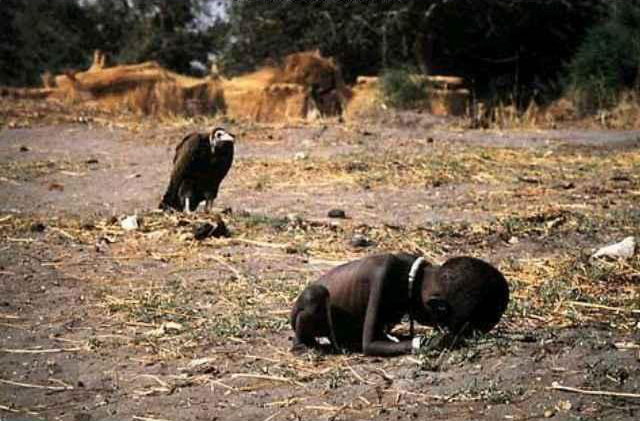
In March 1993, photographer Kevin Carter made a trip to southern Sudan, where he took the now iconic photo of a vulture preying upon an emaciated Sudanese toddler near the village of Ayod. He snapped the haunting photograph and chased the vulture away.
Carter eventually won the Pulitzer Prize for this photo, but he couldn't enjoy it. "I'm really, really sorry I didn't pick the child up," he confided to a friend.
Consumed with the violence he'd witnessed and haunted by the questions as to the little girl's fate, he committed suicide by carbon monoxide poisoning three months later.
This is my poem based on the photograph in tribute to Kevin Carter. It was awarded honorable mention in the Scribophile "Humanity in Poetry" contest.
Child's Pose
I've wiped the lens
with the edge of my shirt
over and over again
each time hoping
to find her
digging grubs from the coolness of mud.
Or sifting millet
with agile fingers
looping through the grains.
Haunched
on strengthened knees,
feet anchored to the ground,
circled hands cupping drops
from the catalyst of rain.
The sharpness has faded,
the background obscured,
but her pose
remains unchanged.
Laid down on the trek,
did she long for the womb,
the fluid float of a weightless embrace
to carry her once again?
Or maybe she sought
to sink beneath
the stratum of clay
to entwine with roots
that would keep her
until Spring.
Earth, too parched to absorb another child
rejected her hunger,
and offered her up
crouched limbs,
caged spine,
bones bracing and
biding
as the talons and lens approached.
The scavenger,
patient and poised,
stilled to her flesh and the
vapored stench
of urine, bile and bowel.
I willed it to advance,
spread wings
just once.
And I waited.
Not a squawk, not a twitch
not a breath, not a click.
A war of observation,
there was no retreat.
The few steps I could have taken
were a vastness bridged by fear.
She held her pose,
too weak to accuse.
I never saw her eyes.
Forgive me.
I'll reside unseen
in the negative space
where the air
leaks promised sleep.
Sunday, June 19, 2011
Pluck: A Poultry Tale + Recipe

"The best way to execute French cooking is to get good and loaded and whack the hell out of a chicken. Bon appétit. "
— Julia Child
There was a time not so long ago when, if I didn't feel like cooking, I would drive a good distance from our house in Savannah to The Fresh Market to pick up dinner. On those evenings, I would grab a basket, walk straight past the wooden tables displaying woven wicker crates bursting with gigantic blush pink apples, baby spinach and arugula. I would shoot past the acrylic, lift-top candy bins and the international chocolate shelf, the artisinal cheese display, the barrels of aromatic coffee beans and the nut grinding station, then weave my way through the biscotti and imported "biscuits" aisle, which brought me to the gourmet deli section. And that's when I would smell it. What I had come for. The rotisserie chicken.
Oh, how I miss that rotisserie chicken: White Wine Herb, Lemon Rosemary, Butter Garlic, Honey and Thyme or Natural (which, they should call "elegantly simple", for that is indeed what it is.) I loved to watch them turning ever- so-slowly on their sabers, the top one dripping it's flavorful cooking juices onto the one below, creating a cascade of savory essence, basting, coating, dripping until each golden droplet suspended and finally splattered and sizzled into the pan below. Watching this process, I theorized that the chicken on the very bottom must be the most flavorful and tender, as it had received all of the drippings from the rungs above. On those occasions when I timed it right and could pick my own chicken right off the rotisserie, that's the one I chose. My piping hot, herb-encrusted chicken nestled inside the foil-insulated bag in my basket, I would wind my way back through the vegetables and fruits (ok, and maybe the international chocolates) to complete my dinner. Those were the days.
In Senegal, I usually dig a chicken out of the freezer chest at our local grocery and dump it into an insulated bag (to keep it cold this time) as quickly as possible. Those suckers are really, really cold. And heavy. Then I met a Senegalese man who raises and sells organic chickens. I ordered one to be delivered the day I was having a dinner party. I would be making Zuni Cafe's famous Roasted Chicken and Bread Salad for one of Richard's new clients and his wife.
On the morning of the party, I was on a roll--I had decided that this time, I was not going to let myself get stressed out. Instead I would be organized, ready, cool and calm. I would have dinner prepared, the table set, my kids bathed, the animals fed and the kitchen cleaned, leaving myself enough time to actually shower and have a much-deserved glass of wine well in advance of our guests arrival at 7:30.
All was going well. I had the bread salad ready at 2:00, or as ready as possible, as the final step is to pour the hot pan drippings over the cubed and grilled bread chunks and then toss with arugula. I had the table set, dessert made, the wine chilling, the green beans trimmed and the orange gremolata ready to pour over the beans once they were cooked. All I needed was the chicken. At 4:00, just as I was putting Sunny and Jamie in the bath, I heard the clip-clop of a horse cart pull up outside. Yes, the chicken. I ran and opened up the gate and there indeed was my organic chicken man, right on time.
He pulled an old rice bag from the back of his cart and reached inside, pulling out a fully-feathered, just killed bird.
"No, no, no", I said, shaking my head. "There must be some mistake. The chicken I ordered is plucked, cleaned and has no head or feet," and, I thought to myself, doesn't look like Ginger the Hen in "Chicken Run" which I had unfortunately watched with my kids the day before.
He laughed and tried to hand me the chicken, but I backed away. "Madame," he said, "you ordered a chicken and that is what I have brought you. You're lucky I killed it for you." With that, he carefully placed the chicken at my feet, got back in his cart and clopped away. I ran after him, hauling the chicken along by the feet, shouting, "but how do I get the feathers off?!! Wait!! Don't go!!"
In situations like this one, (i.e. an entire three pound chicken that needed to be de-headed, de-clawed, plucked, "voided", washed, prepared and roasted in two and a half hours), I have been known to succumb to something akin to Tourette's Syndrome. Sunny and Jamie ran outside with towels on to see why Mommy was standing in the courtyard shouting obscenities, holding a dead chicken by the neck.
"Get your father on the phone, now! . . . Please."
As I tried not to hyperventilate, I heard Sunny, who loves nothing more than to push the #1 button on my cellphone to call her Papa, leaving Richard a message:
"Papa, it's me, Sunny. You better get home soon. Mama's cursing at a chicken. She used the really bad word."
I frantically Googled "how to pluck a chicken". A surprising number of results popped up. I decided to skip the Mount Calvary Missionary Baptist Church video on YouTube entitled "Ms. Dudley Shows How to Pluck the Chicken" because it was seven minutes long and I didn't have seven minutes. I did however bookmark it for later viewing. Scrolling down, I learned fairly quickly that one only need place the chicken in a pot of boiling water and let it sit until the feathers loosened and could be easily removed.
While the chicken sat in it's pre-pluming bath, I thought it would be a good idea to sample the wine. Two glasses later, I reached into the pot, pulled out the chicken and realized it would be easier if I got the neck/head and feet off first. I somehow managed to do this rather smoothly, finding the joints easily. That accomplished, I took a deep breath, reached into the pot (which had now cooled slightly) and began ripping feathers out. The downy ones came out quite easily, but the wing feathers were more stubborn, so I asked Jamie to please find my eyebrow tweezers. By now, our three cats had become very interested in what I was doing and had climbed onto the counter and were pacing like circus tigers. Tweezers in hand, I began to tug at the more difficult quills. As my hands were wet, I was covered in chicken feathers which were plastering themselves all the way up my arm. Sunny had pulled up a stool next to me and was cheering me on. "You're doing a great job Mom." She kept asking me if I didn't want another glass of wine.
At 6:00, the chicken was naked as a . . . well, you know, and I braced myself for removing the innards. I got a scrap bowl out, cut the skin around the cavity and reached in. I don't know that I could identify what I pulled out, but I placed it all in the bowl to cook later for the cats. I scrubbed my hands, arms and the chicken clean, inside and out, and placed it in a roasting dish. It looked just like it was supposed to! I felt triumphant, giddy, plucky even!
Just as I was popping my beautifully dressed and tressed chicken into the oven, one of the cats snatched the entrails out the bowl and trailed them across the counter, down the hallway and up onto Sunny's bed where she proceeded to gnaw on them ferociously and howl at me viciously if I tried to get near her. The resulting mess topped my 'grossest thing ever' list, Sunny's bed had to be changed and Sunny herself needed lots of comforting. She feared that her favorite Hello Kitty sheet (ironic, don't you think?) would never be the same. And, I found, I needed another sip of wine.
Twenty minutes later, I had just enough time to wash my face, brush my teeth and throw on a dress and some lipstick. My cheeks already had that healthy 'just plucked a chicken in record time while downing a bottle of wine' adrenaline glow, so I skipped the blush. The chicken was starting to smell pretty good and, although the recipe doesn't call for it, I basted it with the remainder of the wine bottle I had so thoroughly sampled. When Richard arrived with our guests, who I was meeting for the first time, I wanted to drag him into a corner and tell him everything that happened, but I would have to save it for later.
Somehow, I got dinner on the table. I nervously waited as our guests took their first bites. No one said anything, so I quickly scooped up a forkfull of chicken and bread salad and was relieved that it had turned out well, really well. The woman turned to me and said, "this chicken is absolutely delicious. Did you use white wine?"
You could say that.
___________________________________________________________________________________________________________________________
Actually, it was excellent, which is why I'm sharing the recipe. If you want to impress someone or simply cook the best roasted chicken dish you've ever tasted, you should give it a go. I didn't read the recipe carefully in advance--the chicken is supposed to be brined two days in advance--oh well. This is a link to my absolute favorite cooking blog and the recipe. Enjoy. Oh, and Bon Appetit!
http://smittenkitchen.com/2008/12/zuni-cafe-roast-chicken-bread-salad/
Friday, June 10, 2011
Stories of Serendipity Part II: The Mechanic

When we first moved to Senegal, many fellow expats warned us not to trust the Senegalese, to keep our distance. A give and take relationship was impossible, they assured us, because the Senegalese, gentle as they may seem, were not culturally capable of a reciprocal friendship. I remember thinking, whenever I would hear such admonissions, and they were frequent, that surely these expats were missing something. They weren't looking deep enough, not able to invest in the time and patience it must take to build a relationship. It seemed like a gross generalization, a dehumanizing one, for all of us. And so, I chose to ignore it.
This story proves them all wrong. It happened to my husband Richard, on a recent ordinary day, which is of course when serendipity is most likely to strike. On this particular occasion, serendipity (such a feminine word) was ushered onto the scene by her ever-watchful companion, karma.
The Mechanic:
A 25-year old Toyota Landcruiser possesses lots of charms, particularly when you live in Africa. Talk about rugged. Talk about sturdy. Talk about able to get us home on a mud path laden with crater sized, rain-drenched pot holes. For all of these reasons and more, we love our car. And everyone knows that an old car, one without computer controls or online manuals, needs a veteran mechanic. A trustworthy mechanic who knows his engines and isn't afraid to take them apart. It took us a long time to find Babou, but we knew he was the one when he listened to our car the first time and said, "she's sick. I can fix her." No technical mumbo jumbo, just a straightforward prognosis with a fair price. He is a professional and an expert--someone we trust.
And so, over the last few months, we've recommended him to friends, acquaintences, business owners--anyone in need of a good mechanic. Word of mouth is how most good news travels here and it's always feels good to know that you are helping all involved.
One day this week, Richard travelled to a remote village to work with an elderly Haitian architect who has built an artist colony. He needed help completing the design and execution of a natural pool, one that uses aquatic plants instead of chlorine, to filter impurities. It wasn't a big job, but one that Richard was happy to work on out of great respect for this gentleman.
As Richard was leaving in the afternoon, he got as far as the next village and realized he didn't have much gas. He pulled over to see how much money he had in his wallet- he would need the equivilent of $20 to get him home. To his great horror, he had forgotten his wallet at home. As he stood outside in the morning heat leaning against the car, wondering how he was going to get home, he pulled out his telephone to call me. No credit. (Cellphones in Senegal work on phone cards which you replenish as you go). He didn't even have the gas required to travel back to his client.
Just then, he heard someone call his name. As he turned around, he saw Babou trotting across the street.
"Babou, what are you doing way out here in the middle of the week?", Richard asked.
He pointed across the street to a car on the side of the road. "I have a client who lives in this village. His car broke down this morning and he called me to come fix it."
They were both a long way from home, on the same day, in the same village, on the same street, at the same time.
Richard felt great relief at seeing not only a familiar face, but a friend. He could wait until Babou had fixed the other car and catch a ride back home. He'd somehow have to get back there to pick up our car, but he'd worry about that later. He was about to explain his predicament when Babou patted him on the shoulder and said,
"I'm so glad to see you. I was going to stop by your house later this afternoon."
"You're welcome any time Babou, but why did you want to see me?"
"I wanted to thank you. You've recommended so many clients to me lately and it has helped my business greatly. I'm no longer struggling. I can sleep at night. You have helped me more than you know."
"Please" he said, "take this as my way of thanks. I know it's not much, but maybe you can buy some gas with it."
With that, Babou handed Richard $20.00.
Tuesday, June 7, 2011
Stories of Serendipity Part I: The Yellow House

"All things are ready if our minds be so."
Shakespeare
I've been thinking alot about serendipity lately. And I'm not the only one. I hear stories all the time about people crossing each other's paths, resulting in a significant exchange, leaving both people with the distinct impression that they were meant to meet, for reasons big or small. Hearing about these stories is serendipitous in itself. It's hard to deny that some intangible force, be it God, Allah, Buddha, the Universe, or wherever we place our faith, helps us work things out together. I might be wrong, but it seems to me that these events tend to occur in direct proportion to our current personal and global fragility. Times are tough and scary. Tragedies touch us either personally or distantly, but we hear of or read about them often. The good news is, if we listen, we will also hear about (or hopefully experience) chance meetings, small miracles if you like, that lend a bit of grace and purpose to our day. And so I would be so bold as to altar Shakespeare's quote to read: "All things are ready if our hearts be so."
Here is one such story, Part I:
The Yellow House:
There is a young Senegalese man who often sings at the top of his lungs in what I presume to be a mixture of Wolof and Arabic. Sometimes he wanders out in the bush behind our house, slowly weaving among the giant Baobob trees. But most often he can be seen outside a nearby uninhabited house, wedged into the corner where two outside walls meet. He sings every day, but always at different times. Most days, I'm ashamed to admit, I want to wring his neck, or ducktape his mouth. There is nothing beautiful or particularly comforting about his singing. In fact, it's rather annoying. But nonetheless plaintive.
This morning I went in search of eggs. As I was walking along the dirt path towards the village, the singer began to wail. I could tell by the direction of his voice that he was in his usual spot, a spot I could not avoid. As uncomfortable as I was, I would have to pass him on my way to the boutique. I have always avoided direct contact with this young man, preferring to glimpse him off in the distance. Afterall, anyone who sings that loudly in the middle of nowhere has to be a little off their rocker, right?
As I approached, he suddenly stopped singing, which for some reason made me feel guilty. I had always envisioned a crazed, desperate individual with frantic eyes. Instead, here stood a calm, if not a little embarrassed, young guy wearing surfer shorts and a Bob Marley t-shirt. I said hello and told him not to stop singing on my account. He shuffled his feet a little and looked down at the ground. It was if he knew I had mocked him. I suddenly needed to make it right between us.
"What exactly are you singing about?" I asked.
"My problems," he replied. "I sing to Allah, but only when there is wind. The wind carries my voice and the echo carries Allah's message back to me."
"That's lovely," I said. "Does it really work?"
"Sometimes."
As I couldn't think of much more to say, I asked his name.
"Moustapha Diouf."
"Nice to meet you, Moustapha Diouf. My name is Ellen."
He half-bowed but did not move to shake my hand, which I took to mean that we had gotten close enough for one day. As I turned to continue along the path, he said,
"Allah has a message for you too."
I stopped. "Oh, really?" O.K., I thought, so the loose screw diagnosis was accurate afterall. Maybe Jim Morrison's got something to say while you're at it, buddy. But I had stopped, hadn't I? I, the jaded Catholic who was hard-pressed to define her "beliefs", had been stopped in her tracks by the possibility that I had a pending message . . . from Allah. At the moment, if felt oddly comforting.
"What is the message?" I ventured.
"I don't know, but you'll find it at the yellow house." And with that, he took up his singing again.
The yellow house is an old, wooden, barn-like structure that is a small miracle in itself in that it stands at all. I don't know how old it is, but I often marvel at the fact that termites haven't devoured it. I pass it every day. It's beautiful in an inexplicable way. But, I thought as I walked along, if Moustapha is right, today it will have new meaning. I walk past the house slowly, peering towards the windows, listening. But I don't really believe, not really. I stop, continue on, circle back. Nothing. No one. I linger in front for a few minutes and then decide to try the door, which is around the back. There is no door. The house, afterall, is abandoned. No one inside, only fallen boards with exposed rusted nails, shreds of faded fabric. I am suddenly crying. It's like someone has just told me there is no Santa Claus. No Santa, no Easter Bunny, no Tooth Fairy, no God, no Allah. No Magical Yellow House with even the smallest tibit of Wisdom.
I continue on to the boutique where I go every day to stock up on sundries. Abdou tells me he doesn't have any eggs yet and to try the boutique a little father along in the village. I trudge my way through a sandy street I am not familiar with and spot the boutique up on the left. As I am about to enter, a little boy runs up to me and sticks out his hand. "Bonjour toubab," hello, white lady. He is about four and offers me a sturdy handshake and huge smile. This cheers me up, so I buy him a piece of candy inside the boutique, but no eggs. They haven't been delivered yet. When I step outside, the little boy is across the street, leaning against the wall. He has a deflated bicycle wheel in his hand and is studying it carefully, trying to find the hole. He sees me and there is that big smile again. When I hand him the candy he throws his arms around my legs. I ask him where he lives. He points to the gate and says, "fi, kai fi", here--come with me," and drags me through the gate. Inside, there is a large courtyard filled with chickens and a few goats. There are plastic buckets filled with laundry in different stages of soaking and a woman in the corner, who I assume is his mother, busy packaging the fresh eggs she has collected this morning. She stands to greet me and says, literally translated, "you are welcome here." I finally take in the house behind her, which is small . . . and crumbling in places . . . but clean and bright. . . . and a lovely shade of yellow.
On my way back home, my eggs tucked into my knapsack, I look for Moustapha. I want to share what happened to me. I listen for his voice, but he is nowhere to be found. The wind has died down.
Wednesday, April 6, 2011
Noah's Ark: Penning About Pets

Several months ago I was browsing the submission guidelines for online literary journals and I came across one that caught my eye. The editors threw out terms like "out-of-the-box prose" and "non-linear thinking" which would "blow their run-of-the-mill fiction-dulled minds." It all sounded great. This was it, I was ready to submit my short story . . . until I came across the following guideline, the last on the list, written in large type and flanked with annoying little asterisks, emphasizing it's weight:
****PLEASE REFRAIN FROM WRITING ABOUT YOUR PETS, OTHER PEOPLE'S PETS, OR ANIMALS IN GENERAL. NO ONE CARES***
Get PETA on the phone! Alert the ASPCA! This is an outrage! I thought of the many books I had read as a child and into adulthood where an animal had been the main character, had conveyed a lesson about love, patience, loss, companionship, trust and perserverence, books I loved and will pass on to my children:
Old Yeller, Where the Red Fern Grows, Black Beauty, All Things Bright and Beautiful, Sea Biscuit, The Cat Who Came For Christmas, just to name a few. Animal Farm for crimminy's sake! Would they have given Orwell a "thanks, but no thanks," simply because there was a pig in his story? Disney/Pixar even got us to flip for a rat with a passion for fusion cooking. Log on to YouTube and you can choose from over 650,000 animal videos. So how could this so-called reputable literary journal say that no one cares about critters?
Just to piss them off, I sent in a story called "Mittens and Me", about a little girl who spends weeks coaxing a small abandoned kitten out of a hole underneath a garden shed, engendering it's trust with small bits of bread soaked in milk only to have the kitten's neck viciously broken by the family dog. The crux of the story really isn't so much about the pain the little girl suffers at the loss of the cat (and the betrayal of the dog), but the family drama that ensues as each member struggles with the decision about whether or not to keep the dog. Arguments break out, alliances are tested and a parental decision is made that may or may not have lasting impact on the relationship between the siblings. I had started the story as a joke, but in writing it, it became more complex, took on a different shape. Probably because it was true.
I named the cat "mittens" because she was grey with white paws and I was eight years old. And I wanted to give the dog away because he had destroyed something more important than the cat. With one primal, instinctual act, he had snatched away my innocence. This was of course not his fault, being a dauchsund and therefore a ratter. He simply didn't know any better. But at the time, I had assumed he was capable of a higher form of thinking and feeling. How could he? was all I could think. I took it personally. And though we never really talked about it, I will always feel guilty that, in the end, my parents decided to give the dog away. His banishment was an indulgent and shoddy trade-off for the pain that my brother and sister suffered, a resentment that hung like thick smog around our house until one day, it was all forgotten. Or maybe we just moved on, filing the event away as part of the fabric of our family's make-up. And that's where the story lies. But without the cat and without the dog, there is no story.
"Mittens and Me" was promptly and not so tactfully rejected with an adviso from the editor: "Next time, please take care to carefully read our guidelines." I had expected as much, but still defend the notion that what we consider good literature, or maybe just a good, sentimental read, can and probably does contain a few stories relating to animals. The human experience, from the beginning of time, has always been, and I hope always will be, accompanied and enriched by our four-legged friends. Just today, I read an article about a dog who had been separated from it's owner during the Tsunami in Japan and was recently reunited with her. Maybe, amidst all the human tragedy we face in the world, all the senseless rage and destruction, we can allow ourselves to take comfort in such a reunion.
All this has me thinking about starting a literary journal (or blog) soley dedicated to stories (fiction,creative non-fiction, poetry and photography) about or relating to animals in the wild or pets. What do you think? Do you have a story to tell?
Tuesday, February 22, 2011
Saliou's Shoes
In a small village in Africa there lived a woman of little means who awaited the birth of her second child. On the night of the full moon, during the harvest, the woman was visited by a prophet in her dreams. He told her he had been sent by Allah and spoke in an ancient tongue, pulling the words like ripe fruit from the koran he held in his hand. Her child, the prophet told her, would be a boy sent to earth to serve Allah. No harm would ever come to this child or her house if she allowed him to fulfill his purpose. When the child turned ten, she must let him go out into the world. The woman was frightened by the vision in her dream, but being a faithful servant of Allah, she took great pride in having been chosen as the vessel. The great rains came the night she birthed the child and she suffered greatly, but she did not complain about her gift, for that was how she saw him. The boy was kind and gentle. But he did not speak. It was said that if he glimpsed a person's soul through the window of the eyes, he would know all, good and evil, which lived within a person. Therefore, he was greatly revered in the small village.The woman took good care of the child until he went out into the world at the age of ten, as the prophet had predicted. The child was often seen in the village walking barefoot along the roads. One day he met a white man, who measured his bare feet and promised to buy him shoes. When the rains came, the man left, but returned one day and presented the boy with a beautiful box. Inside was a pair of leather sandles, and the man put them on the boy's feet. The shoes fit him perfectly and the man smiled brightly at the boy. The boy smiled back and looked deeply into the man's eyes before continuing his walk. The man watched him go. The boy stopped several children as he made his way through the village and asked them each to try on his beautiful new shoes. When he had found a little boy whose feet fit the shoes, he buckled them onto the child and walked away . . .
I first met Saliou about two years ago, shortly after we came to Senegal. I pulled up to the bakery one morning and was about to open the car door when a small, smiling face appeared suddenly in the window. "Oh, hello", I said. He didn't respond, but hopped up onto the runner of the car and crossed his small arms carelessly at my open window, still smiling and cocking his head a bit to the left as though offering his cheek for a kiss. He then looked me straight in the eyes, an unusual intimacy for a Senegalese child to bestow upon a white person, especially an adult white person, and one he had yet to meet, officially. As he gave no sign of wanting to move, I suggested he get down so I could get out of the car. "Aaahhh," he said, drawing out the word, which I took to mean that he thought it was a good idea. He jumped down and made a sweeping gesture towards the bakery door, a gallant (and I realized later, practiced) move, as though it were his and he was inviting me inside. He was barefoot and his clothes were threadbare and stained. Judging from his height, I guessed he was about nine or ten. His eyes , which were bright and clear, seemed familiar somehow, and his mouth was unusually large (or was it just the effect of his easy smile?), the teeth square and slightly brown near the gum.
"What's your name?" I asked first in French, then in Wolof, when he didn't answer. He tapped one finger lightly on his chest and opened his eyes wide. "Yes, you, what's your name?" At this he looked up at me and then back to the ground. "Mangui tudou 'Ellen,' I offered. He closed his eyes firmly for several moments, the long lashes fluttering, as though he was considering what my name might look like before committing it to memory. Then he gathered the fingers of his right hand to his thumb and swept the fist towards his mouth, took my hand and pulled me towards the bakery door. "You're hungry, I guess," and there was that smile again and something like a grunt of relief. That was when I understood that, although this little boy could hear, he didn't, couldn't or refused to speak.
The yeasty smell of fresh-baked bread, creme-filled pasteries, egg-washed brioche and baked apples filled our noses, while Saliou's eyes feasted on the glass case filled with paper doilies proffering early morning delights as more were being pulled from the oven on large warm trays. We were greeted with friendly smiles and nods. No one seemed to be surprised that I was holding Saliou's hand (this child I had just met) and they all said hello to us as though we were a common, familiar sight. Saliou pointed enthusiastically at several pasteries, but as I only had one small coin, enough to buy a baguette, I said no, no, no to him. Throughout his persistance, he never stopped smiling. Once we were outside, I broke off a large piece of the warm bread and gave it to him. He nodded several times, held his hand up for a high-five and walked off. He stopped briefly at the edge of the parking lot and handed the bread to a little girl who was crying and pounding the ground with her fists as her mother re-tied her sarong which had blown off.
I saw Saliou frequently from that first day on, always on his way somewhere, always stopping to greet someone with a hug, a slap, a high-five. Everyone knew him. I began to notice that he had a perfunctory vocabulary of signs which he used to communicate with people. I also came to understand that he was able to speak, as he parroted words and phrases that he found amusing. "Sailou," I said one time, "your pockets are inside out." "Pockets. Inside. Out", he repeated, giggling as I tucked the empty white pouches back into their folds. Someone told me later that he did this on purpose to let people know he didn't have money for food, his very literal sign for empty pockets, pocket's empty.
Saliou would often spot me as I was going into the grocery store and help me do my shopping. He would throw his arms around my legs by way of a greeting, then take my hand. I'd tell him three things to go get and he'd return and dump them into the basket, smiling and proud. "What's next?" his eyes would plead. Or if Sunny and Jamie were with me, I'd make it a game of who could get their item fastest (without running) and off they'd go on the count of three. Saliou invariably won. On one such shopping day, we were waiting in line to check out when a french woman who was standing behind us said to Saliou, "little boy, you shouldn't be running around barefoot. Where are your shoes?" He looked at her, then at me and took my hand. Giving me a disdainful onceover, she loudly demanded, "why don't you buy him some shoes?" I didn't know what to say.
The next time I saw Saliou, I asked him on a whim to take me to meet his mother. I wanted to talk to his family, assuming he had one. I wanted to ask if I could buy him some shoes. "Ana Mama?" I asked him, pulling his arms gently from around my legs. "Ana?" he repeated. "Yes," I said. "Where is your mother?"
"Mama," he said and reached up and touched one of my breasts. "No, Salou!" and I batted his hand away instinctively and covered my chest. He seemed confused and hurt by this and I felt immediately ashamed, because, of course, this was the most basic and innocent sign for mother. The breast and underneath it, the heart. "I'm sorry," I told him. "It's alright. Let's go find Mama." Taking my hand, he walked hurriedly through the village along the main street and led me into the Cyber Cafe. He ran to a French woman behind the counter and she kissed him on the head.
"Bonjour Saliou," she said, winking at me. "What kind of trouble are you up to today?"
"Hello," I said and shook her hand. "Are you Saliou's mother?" I asked, thinking perhaps he was of mixed race or had been adopted (the same assumption the french woman had made about me in the grocery store). She laughed kindly and said no, that she knew the family and sometimes looked after Saliou. I wondered what she meant exactly and was about to ask when the phone rang and she indicated that she needed to take the call. She tossed Salou a piece of candy, which he put in his pocket before he led me outside.
"Saliou," I reprimanded, "I don't have time for this. Where is your Mama?" He frowned, mocking my expression and then spread his smile exaggeratedly, as if to say, 'chill out, lady' and pointed down the street. We now progressed slowly through the village as I waited each time he stopped to greet people he knew. His pockets began to fill up: a small box of matches, a tissue for his nose, a small toy car with the wheels missing, a clothes pin, the piece of candy, a coin or two. He finally stopped at a small fruit stand that I was familiar with. He sat down on the bench next to the Senegalease woman whom I had bought fruit from many times. She handed him a banana and playfully pinched him under the chin. "Ooowww" he said and entwined his arm through hers. I said hello and asked if she recognized me. "Of course," she said. "You like mandarines. How are you, Sourna si?" We exchanged pleasantries for a minute and then I ventured, "So, I didn't realize you were Saliou's mother?" She looked at Sailou who was looking for something under the table. "I'm not," she said, "but I've known Saliou since he was born. He is a very special child." I had heard him described this way many times before.
We had walked from one end of the village to the other by now and I was feeling exasperated, ready to abandon my idea of meeting Saliou's mother. He was leading me on a goose chase. I bought some mandarines, said goodbye and turned to make my way back through the village. Saliou caught up to me and began pulling me in the other direction. "Salou, this isn't a game." When he looked at me, the smile was gone. And in the absence of that smile, I saw for the first time ancient eyes that belonged not to a careless child, but to a burdened soul searching for small evidences of kindness. I looked away from those penetrating eyes, but I had seen it, the sorrow. I took his hand again and he led me towards the Art Centre. We entered the main breezeway where several young artists who were working on large paintings looked up at us. Salou turned to me and put his forefinger to his lips. Silence. I nodded. Yes, Salou, we must be silent.
He opened doors and walked with authority through a maze of studios until we reached the last one at the back of the building. He opened the door and inside were two Senegalese students working on life-sized paper mache figures and another in the corner rythmically gliding his hands across a Jembe drumb. And with them was Barbara, an Italian woman I had recently met and liked very much. Saliou ran to her and she picked him up and saddled him on her hip like a baby, his arms wound around her neck, his head neatly lying in the crook of her neck. And then I understood. Saliou had many mothers, women who took care of him in large and small ways. And when he had touched my breast earlier, he was letting me know I was one of them. When Saliou went over to play the drum with his friend, I asked Barbara how she knew him and she explained that his real mother worked for her and was a close friend. Barbara was putting Saliou's older sister through school and had paid for his education until the school refused to teach him. They couldn't provide the extra attention he needed.
"But, what's wrong with him exactly?" I asked.
"Nothing, technically speaking. No offense," Barbara said, "but you're not the first white person to take an interest in Saliou. He's been seen by an ear, nose and throat specialist, a speech therapist, a psychologist, has had brain tests, hearing tests, tests for learning impairments. You name it. Salou's father was an alchoholic before his mother left him and came to work for me, and although I don't know all the details, he must have seen and heard some pretty horrendous things at an early age. I think perhaps he has suffered a trauma, but there is nothing pysically wrong with him.
"But why is he always on the street, barefoot and dirty? Why does she neglect him? Why doesn't his mother take care of him? Why doesn't she buy him some shoes?" I was angry at this woman, even though I had never met her. As one mother to another, I hated her and I began to cry. It was then that Barbara told me the story, his mother's belief that he was sent to earth to serve Allah in some special way.
When I had finished talking with Barbara, Saliou walked me back through the village to my car. He held his two fists out and turned them, like he was turning a wheel, his way of letting me know he wanted to go for a ride. "No, Saliou," I said. "I can't take you to today. I have to get home and make dinner." As it was, I had spent much more time than I had planned. Sunny and Jamie would be waiting for me. I got in the car and he closed the door for me and as he did, he left greasy, black fingerprints on the white car door just below the window frame. Not smudges, but clearly visible traces of the lines and arcs of his unique and complex humanity. On the drive home, I thought about the incredible story that Barbara had told me and the many ways I've heard Saliou described: retarded, mute, an indigo child, special. And now an instrument of Allah. Was there any truth to his mother's story? Did she really have a vision? Did she really believe he was sent by Allah? Or was it a means of not having to take responibility for a child who didn't speak, a child who reminded her of pain. I would never know. I thought about his smile and how I would describe him. And one word came instantly. Free.
Subscribe to:
Comments (Atom)