Thursday, May 24, 2012

More.com Article I
I wrote this for More.com at the end of year one, not knowing how long we'd stay. It's now going on year four!
http://www.more.com/reinvention-money/second-acts/life-changing-year-senegal
http://www.more.com/reinvention-money/second-acts/life-changing-year-senegal
Wednesday, May 16, 2012
Two Foodie Poems

For me, going into a really good patisserie is more exciting than going into a jewelry store . . . and less expensive. These delicacies remind me of little jewels. Feeling down? There's nothing a pastry can't fix. The drawback here, is that, unlike jewelry, you can't wear them . . . accept on your ass.
My tribute to French pastries . . .
Patisserie
Baubles behind glass
Kneaded, braided, beaded and glazed
Edible gold leaf flutters and settles
Upon the skin of cooled confections.
A cream puff ring!
Ribbons of marbled marzipan?
Delicately dusted truffles
in ruffled slips await
My choice.
Crumb-dotted doilies, I fear
Reveal remnants of a salted butter crust,
a must.
I am too late.
Single sweet, powdered pearls
Sit upon the footed Macarons,
Nectarous and toothsome!
Pedestaled and perfect in lavender or coco.
Chanel? no.
Better in fact
For the palette distracts
all momentary woes.
This poem was inspired by a Martha Stewart-like evening when I decided to tackle a recipe at 5 pm without looking at it beforehand. It looked simple until I got half-way through and didn't have half the right ingredients.

Out of Thyme
Turn on the oven to 375,
and while it's preheating
Sharpen your knives.
Cube the lamb
and toss it in flour.
This recipe will have you
in Morocco in an hour.
Now drizzle the olive oil
Over julienned slices
of carrots and onion,
Then add in your spices
Hand-ground, of course
To release the aromas
Which pair quite well
With a Merlot from Sonoma.
You did buy the wine?
It was mentioned in step six
of the pre-recipe section called
"Timing tips and tricks."
Next, delicately brown
the beef on all sides
Until the butter stops frothing
and the sizzle subsides.
This should take no more
Than six minutes at best,
During which time
You should remove the zest
From three-quarters of an orange
and half a Meyer lemon
Which you'll turn to confit
to serve with flatbread from Yemen*
* A must if your aim
is to wow your guests.
Make it two days ahead
Then let it rest.
Now add your home-made stock,
Along with the citrus preserves.
And while those flavors are mingling
Make the goat cheese -scented hors d'oeuvres.
While the stew is in the oven
Make sure your linens are fresh
Now set the table with the clay tajines
Imported from Marrakesh.
You should be right on schedule!
Plenty of time to shower and dress
Perhaps do a short meditation
to eliminate any pre-dinner stress.
Now right before your guests arrive
Chop a handful of thyme or two
and gingerly sprinkle it into the pot.
It's the key to a successful stew.
The odors at this point
Should be simply sublime . . .
Unless, of course,
you've run out of thyme.
Thursday, May 3, 2012
I Remember You
On a recent Friday morning, I walked along the dirt path towards the village to buy tapalapa, the local bread which my friend Abdou bakes in a wood-burning oven at his house and transports to his small shop by horse and cart every morning. It was just before 8 am and the Senegalese students were lingering outside the village high school talking, laughing, sharing clove-infused coffee and bread filled with spiced lentils. The girls sat primly in a row on the wall surrounding the dilapidated buildings, their heads veiled despite the early-morning heat, their skirted legs dangling, heals absent-mindedly nicking away at the cement. The boys jostled each other, or danced, or whispered and scuffled the pebbles on the ground, their text-books forgotten in the dust. Some of them smiled but just as quickly forgot I was there. They are used to me by now. I've walked past this school a hundred times and always noticed the students, greeted them, but on this particular morning, I really saw them. And they seemed like every other teenage kid, all over the world, trying to get by, waiting for life to happen. They seemed like me, at that age.
Thousands of miles away, in Durham, North Carolina, close friends, acquaintances and people I hardly knew were starting to gather, little by little, for our 25th college reunion. I imagined what it would be like to set foot on campus and see all those young students on their way to somewhere, looking up and seeing US, name-tags dangling from our necks. Would we seem old and out of place, as I surely do to the African teenagers in my village? Did we still belong there, or would we simply be visiting a four-year-long memory that now belonged to them? I thought of what it might feel like to walk into that first reunion event and see a familiar face, the eyes first, because they don't change, and then the smile and finally the composite, older now, but still intact and full of intent. I imagined conversations, not the brief and superficial sort, but ones filled with admission and courage, humor and pathos. Would old insecurities creep back, even for an instant, or have they been quieted by the more substantial hurdles and triumphs of our adulthood? Marriage, children, divorce, cancer, success, floods, war, failure, loss, love, time. I suddenly wanted to be there, desperately, although it was impossible for many reasons.
Months back, when people began posting on the Duke reunion Facebook page, back when there was still the slightest possibility of going, it struck me how easy it all seemed, how so many people were taking the time and effort to be there. Thanks to a social media site originally intended for college students and someone like Hester Old Sullivan to use it to its full advantage, we had a "place" to go to check in, ask questions, get information, share anecdotes and memories months ahead of the actual event. It seemed to put everyone at ease and generate excitement. A common theme I saw over and over was "will I remember their names?"
The Senegalese, like most Africans, live in the present, very much on a day-to-day basis. Their lives are first and foremost about meeting needs. The past is not dwelt upon. Most do not know their birthday or the year they were born. Even tragedy and death, felt profoundly in the moment, are left behind quickly. Nor do they project themselves into the future, coveting the goals and commodities of tomorrow. As a result--or in spite of this, I'm not sure which--they are genuinely happy people. When you see a Senegalese person, whether you know them well or have just met them, they often say, "I remember you," which is a greeting of respect and holds several meanings: "I know who you are and how we met", and secondly "you had an impact on me". But most importantly, "I remember you" also means "I keep you in my thoughts and my heart."
Much to my dismay and the annoyance of my family, I spent reunion weekend not in Durham, NC, but in N'gaparou, West Africa, glued to Facebook, reading posts, looking at pictures, wishing I were there, thinking about how much I missed my old friends and wondering if I would have made new ones. But as I read and scanned pictures, I somehow felt a part of it, if only as a voyeur glimpsing pieces of the puzzle. And even though I only gleaned the punch lines, I knew the jokes had been good. And so I laughed, just imagining the possibilities.
 Long before the virtual FB existed, there was a real facebook (remember it?), black and white photos of us as eighteen year olds before we knew each other. My copy got dog-eared and smudged those first few weeks as I looked at all those faces--who are they, these people? At that time, I was guilty of labeling people and trying to put them in neat categories. I needed to define them concretely because I don't think I had any idea who I was, at that age. But as I followed reunion weekend, often in the dark, it was clear that what we thought defined us in college, the various groups, associations, greek affiliations, etc. had receded and what was left were adult individuals who wanted to spend a weekend together, not just reminiscing about old times, but creating new memories. Celebrating being with each other as we are now. In the present. And the best part is, the thread continues, which carries an important message for us all . . . I remember you.
Thousands of miles away, in Durham, North Carolina, close friends, acquaintances and people I hardly knew were starting to gather, little by little, for our 25th college reunion. I imagined what it would be like to set foot on campus and see all those young students on their way to somewhere, looking up and seeing US, name-tags dangling from our necks. Would we seem old and out of place, as I surely do to the African teenagers in my village? Did we still belong there, or would we simply be visiting a four-year-long memory that now belonged to them? I thought of what it might feel like to walk into that first reunion event and see a familiar face, the eyes first, because they don't change, and then the smile and finally the composite, older now, but still intact and full of intent. I imagined conversations, not the brief and superficial sort, but ones filled with admission and courage, humor and pathos. Would old insecurities creep back, even for an instant, or have they been quieted by the more substantial hurdles and triumphs of our adulthood? Marriage, children, divorce, cancer, success, floods, war, failure, loss, love, time. I suddenly wanted to be there, desperately, although it was impossible for many reasons.
Months back, when people began posting on the Duke reunion Facebook page, back when there was still the slightest possibility of going, it struck me how easy it all seemed, how so many people were taking the time and effort to be there. Thanks to a social media site originally intended for college students and someone like Hester Old Sullivan to use it to its full advantage, we had a "place" to go to check in, ask questions, get information, share anecdotes and memories months ahead of the actual event. It seemed to put everyone at ease and generate excitement. A common theme I saw over and over was "will I remember their names?"
The Senegalese, like most Africans, live in the present, very much on a day-to-day basis. Their lives are first and foremost about meeting needs. The past is not dwelt upon. Most do not know their birthday or the year they were born. Even tragedy and death, felt profoundly in the moment, are left behind quickly. Nor do they project themselves into the future, coveting the goals and commodities of tomorrow. As a result--or in spite of this, I'm not sure which--they are genuinely happy people. When you see a Senegalese person, whether you know them well or have just met them, they often say, "I remember you," which is a greeting of respect and holds several meanings: "I know who you are and how we met", and secondly "you had an impact on me". But most importantly, "I remember you" also means "I keep you in my thoughts and my heart."
Much to my dismay and the annoyance of my family, I spent reunion weekend not in Durham, NC, but in N'gaparou, West Africa, glued to Facebook, reading posts, looking at pictures, wishing I were there, thinking about how much I missed my old friends and wondering if I would have made new ones. But as I read and scanned pictures, I somehow felt a part of it, if only as a voyeur glimpsing pieces of the puzzle. And even though I only gleaned the punch lines, I knew the jokes had been good. And so I laughed, just imagining the possibilities.

Wednesday, April 25, 2012
Green Gone Wrong: A Satire

Memo to the Staff from the CEO:
It has recently come to my attention that several gross violations of our company's policy for a greener planet have taken place. So as not to embarrass the guilty parties, I will refrain from citing specific names. However, I will address the infractions in detail in the hope they will serve as a cautionary reminder that each and every employee is responsible for upholding the values and reputation of this company as a sustainable investor in the future. In concise terms, I feel it is my duty to bring your attention to the specific examples below:
Exhibit A: A member of the cleaning staff, who wishes to remain anonymous, recently witnessed an employee pressing the low-flow timed water button three times in the course of one hand-washing. To add insult to injury, this same individual served him/herself to two pre-measured glycerin-based soap servings from the wall dispenser. This is a flagrant trespass of responsible lavatory practices and will not be tolerated. Not only is this information clearly noted in your employee handbook under "Self-serve low-flow water and glycerin-based soap portioning," but is further reinforced with neutral-gender stick figure illustrations indicating one low-flow water press to moisten, followed by a single soap application and one additional low-flow water press as a final rinse. Please avail yourselves of this visual aid each and every time you visit the lavatories.
Exhibit B: Yesterday, an individually packaged, half-eaten Hostess Twinkie was found in the back of the company refrigerator, further concealed in a non-recyclable plastic grocery bag. The presence of the offending snack cake in fact violates three company regulations, all of which are clearly stated in your handbook. The first is our ban on chemical food additives in the workplace. Just because Jimmy Carter (former U.S. President, 1977-1981) put one in a time capsule doesn't make it a healthy food choice. The second being our ban on plastic bags in general and the third being our strict policy of no individually wrapped food items. While I hate to pour proverbial lemon juice on an already open wound, the Twinkie was three weeks past it's due date. Need I say more?
Exhibit C: I have it on good authority that a red Honda Prius (wouldn't white be a better choice in creating a comfortable mobile micro-climate people?) was seen pulling into the employee parking lot with only two passengers inside. This violates our carpooling policy (Section F, Sub-Section II, paragraph 565) stipulating three or more occupants. The missing third occupant was seen arriving several hours late in her own car, her excuse being a "medical procedure." Please organize car-pooling more efficiently and please take care to schedule all "medical procedures", (including home births) during weekend, evening and scheduled vacation time. This brings me to the next infraction.
Exhibit D: Two months ago, I personally approved a two-week eco-vacation for one of you in Mongolia to help build a school for Buddhist children. I later learned that not only did this individual neglect to purchase the required carbon offset credits for the CO2 emissions given off during plane travel, but rode a camel on several occasions during his stay. While camels are not specifically noted in your handbook, we all know that they are rude ruminants who belch and flatulate methane into the environment at an astonishing rate, contributing an approximate 14% of global warming emissions. The unfortunate fact that these cud-chewing, saliva slobbering animals are the only means of transporting materials in the Gobi dessert is no excuse. A comfortable pair of walking shoes with good arch support should be every green citizen's staple while on vacation.
As a general note, when planning your eco-vacations, shopping or eating, I would advise you all to be wary of widely overused marketing techniques that in most cases have no substance behind them. Research your purchases diligently. Don't hesitate to request a company profile on the manufacturer of those "organic" socks you've been considering. Check in on that "eco-charity" you're contributing to. Is part of your hard-earned paycheck really going towards "aid" in Africa or "reforestation" in the Amazon? Most importantly, when at work (where you spend most of your time) follow your company handbook to the letter. Why not spend your lunch hour today revisiting company regulations? Think about how your actions can have consequences that reach above and beyond the walls of your cubicle. And when you walk through the doors of this building at the end of the day, you can feel proud that you work for a company who watches your back.
Sincerely,
Jack Emalloff, CEO ACME Toxic Waste Management
This memo was electronically sent. Save a tree.
Friday, March 23, 2012
The Extra Layer
A mother I know lost her son this week, her oldest child. He was sixteen. First he was missing. Then he was found by a search team alongside the road where he had apparently been hit by a car in the early morning darkness. The details are still unclear. But do they really matter? He is gone. Somehow I imagine that knowing must be better than missing because missing means uncertainty. And in the face of uncertainty, we imagine the worst. And hope for the best. But in knowing, we reach the truth, the depth of death and loss that we all experience differently. And although we may sink into that pain like fresh mud, at least we are not floating away. And when we are ready, there is the pulling grace of goodbye, the loveliness of memories. The detail of the lips moving, the voice like honey, thick and soothing, buzzing still.
My husband's cousin, a painter, did a series of works in which he illustrates that we each carry with us all the disappointments, cruelties and losses of our lives as bricks. The proverbial baggage. Some of these bricks fall away as we get older--the self-doubts, the useless criticisms, the rejections that no longer serve us. But I believe certain losses never leave us. We don't "get over" them, we simply learn to lift ourselves up with them, walk with them, adapt to their weight and presence, perhaps occasionally forget they are there. Shift them about. Maybe even soar with them in a moment of laughter. But never, never put them down. I have always hated the saying "time heals all wounds," which implies that we are responsible to open our eyes on some undetermined bright morning and find the wound scarred over, run our fingers over a place that was once raw and bottomless to find a bumpy ridge of dullness. The forgetting. I have not lost a child. But I have lost my father and a dear friend and I prefer to think of them as always with me, not as a burden of grief, but an extra layer.
This woman who lost her son is a friend of a friend. Someone you love by extension, because your friend does. I met and spent three days with her several years ago. We walked 49.5 miles together with several other friends to raise money for breast cancer. We crossed Chicago together. I guess when you walk that many miles with someone, the "getting to know you" process is accelerated. Sweat and blisters cut through the veil of appearances and you have no choice but to be yourself. I have a vivid image of Deborah, long legs and girlish braids, a glamorous Pippy Longstocking who I had trouble keeping up with. And although I haven't kept in touch with her regularly or ever met her family, I know about them. Which is enough. It's enough to know.
During our walk, we women shared the details of our lives, some mundane--what sports our kids played and how our husbands made us crazy, which recipes we'd tried lately, the music we liked, what we were like in college. And some more poignant--a birth story, relationship worries, a battle with cancer. The miles and the time passed until we reached the next rest point where we could stop and eat, drink water, stretch, rest. Getting up again was always the hardest part, exhaustion anchoring us to the ground, the grass, the dirt, the ants. Deborah was always the first to say, "Ok, time's up, let's get going." And up she got, the rest of us struggling to our feet to catch up. Keep going.
The following year, another good friend who walked with us died unexpectedly of coronary thrombosis. I flew from Africa to her funeral in Michigan with the numbness of grief and no warm clothes. It was early January, deep drifts of snow covered the ground. Deborah sent me a sweater in the suitcase of our mutual friend -- a long, soft, gray blanket of a sweater. A new sweater, an expensive sweater, which she pulled off the shelf of her clothing store--because she thought of me--which is an extraordinary gesture for many reasons and one I'll never forget. I wore that sweater during the funeral, I slept in that sweater, wrapped it around my shoulders, my waist. It became both a shield and an embrace. I slipped it over my head on the airplane going back to Africa, not because I was cold, but because I needed to feel the familiar drape. It had become a different sort of extra layer, threads of comfort woven into the fibers. The comfort that comes from being with good friends who loved the person you miss, the talk, the smells, the touches and tears. Even the laugh that escapes unexpectedly and uncontrollably--that first inevitable laugh that feels like a betrayal, but is really the soul of your friend, or father, or son, or mother telling you it's ok to live on.
When I woke up this morning, it was cool, maybe not worthy of a sweater, but I put in on anyway. The sleeves are now stretched past my fingertips and the hem is dotted with pilled knobs of worn wool. I sat on my bed and pulled the sweater over my knees and tried to send my thoughts across the ocean to someone who once showed me kindness. But the tragedy felt too large and far away, like I could travel and travel and never reach an understanding. A child gone. I thought that maybe I should send the sweater to Deborah, that somehow it would help. But what if it didn't feel the same to her, if it didn't fit, couldn't comfort? In all the certain gestures of family, friends, neighbors and even strangers, I hope she'll find her own extra layer. And when she does, it will make a small difference. It will.
My husband's cousin, a painter, did a series of works in which he illustrates that we each carry with us all the disappointments, cruelties and losses of our lives as bricks. The proverbial baggage. Some of these bricks fall away as we get older--the self-doubts, the useless criticisms, the rejections that no longer serve us. But I believe certain losses never leave us. We don't "get over" them, we simply learn to lift ourselves up with them, walk with them, adapt to their weight and presence, perhaps occasionally forget they are there. Shift them about. Maybe even soar with them in a moment of laughter. But never, never put them down. I have always hated the saying "time heals all wounds," which implies that we are responsible to open our eyes on some undetermined bright morning and find the wound scarred over, run our fingers over a place that was once raw and bottomless to find a bumpy ridge of dullness. The forgetting. I have not lost a child. But I have lost my father and a dear friend and I prefer to think of them as always with me, not as a burden of grief, but an extra layer.
This woman who lost her son is a friend of a friend. Someone you love by extension, because your friend does. I met and spent three days with her several years ago. We walked 49.5 miles together with several other friends to raise money for breast cancer. We crossed Chicago together. I guess when you walk that many miles with someone, the "getting to know you" process is accelerated. Sweat and blisters cut through the veil of appearances and you have no choice but to be yourself. I have a vivid image of Deborah, long legs and girlish braids, a glamorous Pippy Longstocking who I had trouble keeping up with. And although I haven't kept in touch with her regularly or ever met her family, I know about them. Which is enough. It's enough to know.
During our walk, we women shared the details of our lives, some mundane--what sports our kids played and how our husbands made us crazy, which recipes we'd tried lately, the music we liked, what we were like in college. And some more poignant--a birth story, relationship worries, a battle with cancer. The miles and the time passed until we reached the next rest point where we could stop and eat, drink water, stretch, rest. Getting up again was always the hardest part, exhaustion anchoring us to the ground, the grass, the dirt, the ants. Deborah was always the first to say, "Ok, time's up, let's get going." And up she got, the rest of us struggling to our feet to catch up. Keep going.
The following year, another good friend who walked with us died unexpectedly of coronary thrombosis. I flew from Africa to her funeral in Michigan with the numbness of grief and no warm clothes. It was early January, deep drifts of snow covered the ground. Deborah sent me a sweater in the suitcase of our mutual friend -- a long, soft, gray blanket of a sweater. A new sweater, an expensive sweater, which she pulled off the shelf of her clothing store--because she thought of me--which is an extraordinary gesture for many reasons and one I'll never forget. I wore that sweater during the funeral, I slept in that sweater, wrapped it around my shoulders, my waist. It became both a shield and an embrace. I slipped it over my head on the airplane going back to Africa, not because I was cold, but because I needed to feel the familiar drape. It had become a different sort of extra layer, threads of comfort woven into the fibers. The comfort that comes from being with good friends who loved the person you miss, the talk, the smells, the touches and tears. Even the laugh that escapes unexpectedly and uncontrollably--that first inevitable laugh that feels like a betrayal, but is really the soul of your friend, or father, or son, or mother telling you it's ok to live on.
When I woke up this morning, it was cool, maybe not worthy of a sweater, but I put in on anyway. The sleeves are now stretched past my fingertips and the hem is dotted with pilled knobs of worn wool. I sat on my bed and pulled the sweater over my knees and tried to send my thoughts across the ocean to someone who once showed me kindness. But the tragedy felt too large and far away, like I could travel and travel and never reach an understanding. A child gone. I thought that maybe I should send the sweater to Deborah, that somehow it would help. But what if it didn't feel the same to her, if it didn't fit, couldn't comfort? In all the certain gestures of family, friends, neighbors and even strangers, I hope she'll find her own extra layer. And when she does, it will make a small difference. It will.
Thursday, September 15, 2011
Child's Pose
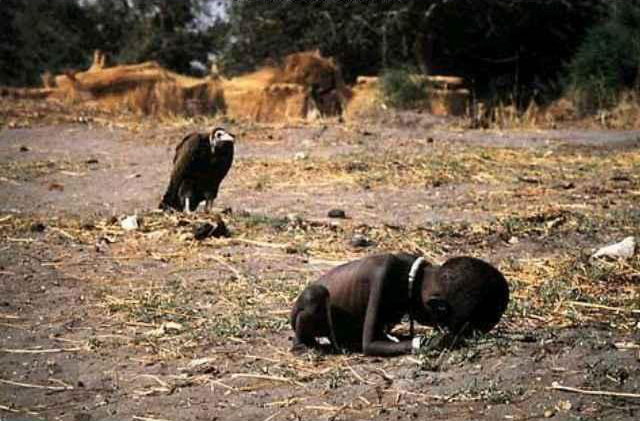
In March 1993, photographer Kevin Carter made a trip to southern Sudan, where he took the now iconic photo of a vulture preying upon an emaciated Sudanese toddler near the village of Ayod. He snapped the haunting photograph and chased the vulture away.
Carter eventually won the Pulitzer Prize for this photo, but he couldn't enjoy it. "I'm really, really sorry I didn't pick the child up," he confided to a friend.
Consumed with the violence he'd witnessed and haunted by the questions as to the little girl's fate, he committed suicide by carbon monoxide poisoning three months later.
This is my poem based on the photograph in tribute to Kevin Carter. It was awarded honorable mention in the Scribophile "Humanity in Poetry" contest.
Child's Pose
I've wiped the lens
with the edge of my shirt
over and over again
each time hoping
to find her
digging grubs from the coolness of mud.
Or sifting millet
with agile fingers
looping through the grains.
Haunched
on strengthened knees,
feet anchored to the ground,
circled hands cupping drops
from the catalyst of rain.
The sharpness has faded,
the background obscured,
but her pose
remains unchanged.
Laid down on the trek,
did she long for the womb,
the fluid float of a weightless embrace
to carry her once again?
Or maybe she sought
to sink beneath
the stratum of clay
to entwine with roots
that would keep her
until Spring.
Earth, too parched to absorb another child
rejected her hunger,
and offered her up
crouched limbs,
caged spine,
bones bracing and
biding
as the talons and lens approached.
The scavenger,
patient and poised,
stilled to her flesh and the
vapored stench
of urine, bile and bowel.
I willed it to advance,
spread wings
just once.
And I waited.
Not a squawk, not a twitch
not a breath, not a click.
A war of observation,
there was no retreat.
The few steps I could have taken
were a vastness bridged by fear.
She held her pose,
too weak to accuse.
I never saw her eyes.
Forgive me.
I'll reside unseen
in the negative space
where the air
leaks promised sleep.
Subscribe to:
Posts (Atom)