Green Gone Wrong . . .
Memo to the Staff from the CEO:
It has recently come to my attention that several gross violations of our company's policy for a greener planet have taken place. So as not to embarrass the guilty parties, I will refrain from citing specific names. However, I will address the infractions in detail in the hope they will serve as a cautionary reminder that each and every employee is responsible for upholding the values and reputation of this company as a sustainable investor in the future. In concise terms, I feel it is my duty to bring your attention to the specific examples below:
Exhibit A:
A member of the cleaning staff, who wishes to remain anonymous, recently witnessed an employee pressing the low-flow timed water button three times in the course of one hand-washing. To add insult to injury, this same individual served him/herself to two pre-measured glycerin-based soap servings from the wall dispenser. This is a flagrant trespass of responsible lavatory practices and will not be tolerated. Not only is this information clearly noted in your employee handbook under "Self-serve low-flow water and glycerin-based soap portioning," but is further reinforced with neutral-gender stick figure illustrations indicating one low-flow water press to moisten, followed by a single soap application and one additional low-flow water press as a final rinse. Please avail yourselves of this visual aid each and every time you visit the lavatories.
Exhibit B:
Yesterday, an individually packaged, half-eaten Hostess Twinkie was found in the back of the company refrigerator, further concealed in a non-recyclable plastic grocery bag. The presence of the offending snack cake in fact violates three company regulations, all of which are clearly stated in your handbook. The first is our ban on chemical food additives in the workplace. Just because Jimmy Carter (former U.S. President, 1977-1981) put one in a time capsule doesn't make it a healthy food choice. The second being our ban on plastic bags in general and the third being our strict policy of no individually wrapped food items. While I hate to pour proverbial lemon juice on an already open wound, the Twinkie was three weeks past it's due date. Need I say more?
Exhibit C:
I have it on good authority that a red Honda Prius (wouldn't white be a better choice in creating a comfortable mobile micro-climate people?) was seen pulling into the employee parking lot with only two passengers inside. This violates our carpooling policy (Section F, Sub-Section II, paragraph 565) stipulating three or more occupants. The missing third occupant was seen arriving several hours late in her own car, her excuse being a "medical procedure." Please organize car-pooling more efficiently and please take care to schedule all "medical procedures", (including home births) during weekend, evening and scheduled vacation time. This brings me to the next infraction.
Exhibit D:
Two months ago, I personally approved a two-week eco-vacation for one of you in Mongolia to help build a school for Buddhist children. I later learned that not only did this individual neglect to purchase the required carbon offset credits for the CO2 emissions given off during plane travel, but rode a camel on several occasions during his stay. While camels are not specifically noted in your handbook, we all know that they are rude ruminants who belch and flatulate methane into the environment at an astonishing rate, contributing an approximate 14% of global warming emissions. The unfortunate fact that these cud-chewing, saliva slobbering animals are the only means of transporting materials in the Gobi dessert is no excuse. A comfortable pair of walking shoes with good arch support should be every green citizen's staple while on vacation.
As a general note, when planning your eco-vacations, shopping or eating, I would advise you all to be wary of widely overused marketing techniques that in most cases have no substance behind them. Research your purchases diligently. Don't hesitate to request a company profile on the manufacturer of those "organic" socks you've been considering. Check in on that "eco-charity" you're contributing to. Is part of your hard-earned paycheck really going towards "aid" in Africa or "reforestation" in the Amazon? Most importantly, when at work (where you spend most of your time) follow your company handbook to the letter. Why not spend your lunch hour today revisiting company regulations? Think about how your actions can have consequences that reach above and beyond the walls of your cubicle. And when you walk through the doors of this building at the end of the day, you can feel proud that you work for a company who watches your back.
Sincerely,
Jack Emalloff,
CEO
ACME Toxic Waste Management
This memo was electronically sent. Save a tree.
An American mom's personal musings, observations and insights into the Senegalese culture
Total Pageviews
Wednesday, April 25, 2012
Friday, March 23, 2012
The Extra Layer
A mother I know lost her son this week, her oldest child. He was sixteen. First he was missing. Then he was found by a search team alongside the road where he had apparently been hit by a car in the early morning darkness. The details are still unclear. But do they really matter? He is gone. Somehow I imagine that knowing must be better than missing because missing means uncertainty. And in the face of uncertainty, we imagine the worst. And hope for the best. But in knowing, we reach the truth, the depth of death and loss that we all experience differently. And although we may sink into that pain like fresh mud, at least we are not floating away. And when we are ready, there is the pulling grace of goodbye, the loveliness of memories. The detail of the lips moving, the voice like honey, thick and soothing, buzzing still.
My husband's cousin, a painter, did a series of works in which he illustrates that we each carry with us all the disappointments, cruelties and losses of our lives as bricks. The proverbial baggage. Some of these bricks fall away as we get older--the self-doubts, the useless criticisms, the rejections that no longer serve us. But I believe certain losses never leave us. We don't "get over" them, we simply learn to lift ourselves up with them, walk with them, adapt to their weight and presence, perhaps occasionally forget they are there. Shift them about. Maybe even soar with them in a moment of laughter. But never, never put them down. I have always hated the saying "time heals all wounds," which implies that we are responsible to open our eyes on some undetermined bright morning and find the wound scarred over, run our fingers over a place that was once raw and bottomless to find a bumpy ridge of dullness. The forgetting. I have not lost a child. But I have lost my father and a dear friend and I prefer to think of them as always with me, not as a burden of grief, but an extra layer.
This woman who lost her son is a friend of a friend. Someone you love by extension, because your friend does. I met and spent three days with her several years ago. We walked 49.5 miles together with several other friends to raise money for breast cancer. We crossed Chicago together. I guess when you walk that many miles with someone, the "getting to know you" process is accelerated. Sweat and blisters cut through the veil of appearances and you have no choice but to be yourself. I have a vivid image of Deborah, long legs and girlish braids, a glamorous Pippy Longstocking who I had trouble keeping up with. And although I haven't kept in touch with her regularly or ever met her family, I know about them. Which is enough. It's enough to know.
During our walk, we women shared the details of our lives, some mundane--what sports our kids played and how our husbands made us crazy, which recipes we'd tried lately, the music we liked, what we were like in college. And some more poignant--a birth story, relationship worries, a battle with cancer. The miles and the time passed until we reached the next rest point where we could stop and eat, drink water, stretch, rest. Getting up again was always the hardest part, exhaustion anchoring us to the ground, the grass, the dirt, the ants. Deborah was always the first to say, "Ok, time's up, let's get going." And up she got, the rest of us struggling to our feet to catch up. Keep going.
The following year, another good friend who walked with us died unexpectedly of coronary thrombosis. I flew from Africa to her funeral in Michigan with the numbness of grief and no warm clothes. It was early January, deep drifts of snow covered the ground. Deborah sent me a sweater in the suitcase of our mutual friend -- a long, soft, gray blanket of a sweater. A new sweater, an expensive sweater, which she pulled off the shelf of her clothing store--because she thought of me--which is an extraordinary gesture for many reasons and one I'll never forget. I wore that sweater during the funeral, I slept in that sweater, wrapped it around my shoulders, my waist. It became both a shield and an embrace. I slipped it over my head on the airplane going back to Africa, not because I was cold, but because I needed to feel the familiar drape. It had become a different sort of extra layer, threads of comfort woven into the fibers. The comfort that comes from being with good friends who loved the person you miss, the talk, the smells, the touches and tears. Even the laugh that escapes unexpectedly and uncontrollably--that first inevitable laugh that feels like a betrayal, but is really the soul of your friend, or father, or son, or mother telling you it's ok to live on.
When I woke up this morning, it was cool, maybe not worthy of a sweater, but I put in on anyway. The sleeves are now stretched past my fingertips and the hem is dotted with pilled knobs of worn wool. I sat on my bed and pulled the sweater over my knees and tried to send my thoughts across the ocean to someone who once showed me kindness. But the tragedy felt too large and far away, like I could travel and travel and never reach an understanding. A child gone. I thought that maybe I should send the sweater to Deborah, that somehow it would help. But what if it didn't feel the same to her, if it didn't fit, couldn't comfort? In all the certain gestures of family, friends, neighbors and even strangers, I hope she'll find her own extra layer. And when she does, it will make a small difference. It will.
Thursday, September 15, 2011
Child's Pose
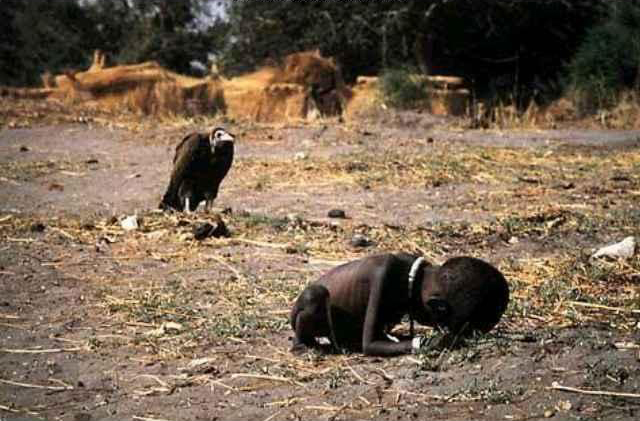
In March 1993, photographer Kevin Carter made a trip to southern Sudan, where he took the now iconic photo of a vulture preying upon an emaciated Sudanese toddler near the village of Ayod. He snapped the haunting photograph and chased the vulture away.
Carter eventually won the Pulitzer Prize for this photo, but he couldn't enjoy it. "I'm really, really sorry I didn't pick the child up," he confided to a friend.
Consumed with the violence he'd witnessed and haunted by the questions as to the little girl's fate, he committed suicide by carbon monoxide poisoning three months later.
This is my poem based on the photograph in tribute to Kevin Carter. It was awarded honorable mention in the Scribophile "Humanity in Poetry" contest.
Child's Pose
I've wiped the lens
with the edge of my shirt
over and over again
each time hoping
to find her
digging grubs from the coolness of mud.
Or sifting millet
with agile fingers
looping through the grains.
Haunched
on strengthened knees,
feet anchored to the ground,
circled hands cupping drops
from the catalyst of rain.
The sharpness has faded,
the background obscured,
but her pose
remains unchanged.
Laid down on the trek,
did she long for the womb,
the fluid float of a weightless embrace
to carry her once again?
Or maybe she sought
to sink beneath
the stratum of clay
to entwine with roots
that would keep her
until Spring.
Earth, too parched to absorb another child
rejected her hunger,
and offered her up
crouched limbs,
caged spine,
bones bracing and
biding
as the talons and lens approached.
The scavenger,
patient and poised,
stilled to her flesh and the
vapored stench
of urine, bile and bowel.
I willed it to advance,
spread wings
just once.
And I waited.
Not a squawk, not a twitch
not a breath, not a click.
A war of observation,
there was no retreat.
The few steps I could have taken
were a vastness bridged by fear.
She held her pose,
too weak to accuse.
I never saw her eyes.
Forgive me.
I'll reside unseen
in the negative space
where the air
leaks promised sleep.
Sunday, June 19, 2011
Pluck: A Poultry Tale + Recipe

"The best way to execute French cooking is to get good and loaded and whack the hell out of a chicken. Bon appétit. "
— Julia Child
There was a time not so long ago when, if I didn't feel like cooking, I would drive a good distance from our house in Savannah to The Fresh Market to pick up dinner. On those evenings, I would grab a basket, walk straight past the wooden tables displaying woven wicker crates bursting with gigantic blush pink apples, baby spinach and arugula. I would shoot past the acrylic, lift-top candy bins and the international chocolate shelf, the artisinal cheese display, the barrels of aromatic coffee beans and the nut grinding station, then weave my way through the biscotti and imported "biscuits" aisle, which brought me to the gourmet deli section. And that's when I would smell it. What I had come for. The rotisserie chicken.
Oh, how I miss that rotisserie chicken: White Wine Herb, Lemon Rosemary, Butter Garlic, Honey and Thyme or Natural (which, they should call "elegantly simple", for that is indeed what it is.) I loved to watch them turning ever- so-slowly on their sabers, the top one dripping it's flavorful cooking juices onto the one below, creating a cascade of savory essence, basting, coating, dripping until each golden droplet suspended and finally splattered and sizzled into the pan below. Watching this process, I theorized that the chicken on the very bottom must be the most flavorful and tender, as it had received all of the drippings from the rungs above. On those occasions when I timed it right and could pick my own chicken right off the rotisserie, that's the one I chose. My piping hot, herb-encrusted chicken nestled inside the foil-insulated bag in my basket, I would wind my way back through the vegetables and fruits (ok, and maybe the international chocolates) to complete my dinner. Those were the days.
In Senegal, I usually dig a chicken out of the freezer chest at our local grocery and dump it into an insulated bag (to keep it cold this time) as quickly as possible. Those suckers are really, really cold. And heavy. Then I met a Senegalese man who raises and sells organic chickens. I ordered one to be delivered the day I was having a dinner party. I would be making Zuni Cafe's famous Roasted Chicken and Bread Salad for one of Richard's new clients and his wife.
On the morning of the party, I was on a roll--I had decided that this time, I was not going to let myself get stressed out. Instead I would be organized, ready, cool and calm. I would have dinner prepared, the table set, my kids bathed, the animals fed and the kitchen cleaned, leaving myself enough time to actually shower and have a much-deserved glass of wine well in advance of our guests arrival at 7:30.
All was going well. I had the bread salad ready at 2:00, or as ready as possible, as the final step is to pour the hot pan drippings over the cubed and grilled bread chunks and then toss with arugula. I had the table set, dessert made, the wine chilling, the green beans trimmed and the orange gremolata ready to pour over the beans once they were cooked. All I needed was the chicken. At 4:00, just as I was putting Sunny and Jamie in the bath, I heard the clip-clop of a horse cart pull up outside. Yes, the chicken. I ran and opened up the gate and there indeed was my organic chicken man, right on time.
He pulled an old rice bag from the back of his cart and reached inside, pulling out a fully-feathered, just killed bird.
"No, no, no", I said, shaking my head. "There must be some mistake. The chicken I ordered is plucked, cleaned and has no head or feet," and, I thought to myself, doesn't look like Ginger the Hen in "Chicken Run" which I had unfortunately watched with my kids the day before.
He laughed and tried to hand me the chicken, but I backed away. "Madame," he said, "you ordered a chicken and that is what I have brought you. You're lucky I killed it for you." With that, he carefully placed the chicken at my feet, got back in his cart and clopped away. I ran after him, hauling the chicken along by the feet, shouting, "but how do I get the feathers off?!! Wait!! Don't go!!"
In situations like this one, (i.e. an entire three pound chicken that needed to be de-headed, de-clawed, plucked, "voided", washed, prepared and roasted in two and a half hours), I have been known to succumb to something akin to Tourette's Syndrome. Sunny and Jamie ran outside with towels on to see why Mommy was standing in the courtyard shouting obscenities, holding a dead chicken by the neck.
"Get your father on the phone, now! . . . Please."
As I tried not to hyperventilate, I heard Sunny, who loves nothing more than to push the #1 button on my cellphone to call her Papa, leaving Richard a message:
"Papa, it's me, Sunny. You better get home soon. Mama's cursing at a chicken. She used the really bad word."
I frantically Googled "how to pluck a chicken". A surprising number of results popped up. I decided to skip the Mount Calvary Missionary Baptist Church video on YouTube entitled "Ms. Dudley Shows How to Pluck the Chicken" because it was seven minutes long and I didn't have seven minutes. I did however bookmark it for later viewing. Scrolling down, I learned fairly quickly that one only need place the chicken in a pot of boiling water and let it sit until the feathers loosened and could be easily removed.
While the chicken sat in it's pre-pluming bath, I thought it would be a good idea to sample the wine. Two glasses later, I reached into the pot, pulled out the chicken and realized it would be easier if I got the neck/head and feet off first. I somehow managed to do this rather smoothly, finding the joints easily. That accomplished, I took a deep breath, reached into the pot (which had now cooled slightly) and began ripping feathers out. The downy ones came out quite easily, but the wing feathers were more stubborn, so I asked Jamie to please find my eyebrow tweezers. By now, our three cats had become very interested in what I was doing and had climbed onto the counter and were pacing like circus tigers. Tweezers in hand, I began to tug at the more difficult quills. As my hands were wet, I was covered in chicken feathers which were plastering themselves all the way up my arm. Sunny had pulled up a stool next to me and was cheering me on. "You're doing a great job Mom." She kept asking me if I didn't want another glass of wine.
At 6:00, the chicken was naked as a . . . well, you know, and I braced myself for removing the innards. I got a scrap bowl out, cut the skin around the cavity and reached in. I don't know that I could identify what I pulled out, but I placed it all in the bowl to cook later for the cats. I scrubbed my hands, arms and the chicken clean, inside and out, and placed it in a roasting dish. It looked just like it was supposed to! I felt triumphant, giddy, plucky even!
Just as I was popping my beautifully dressed and tressed chicken into the oven, one of the cats snatched the entrails out the bowl and trailed them across the counter, down the hallway and up onto Sunny's bed where she proceeded to gnaw on them ferociously and howl at me viciously if I tried to get near her. The resulting mess topped my 'grossest thing ever' list, Sunny's bed had to be changed and Sunny herself needed lots of comforting. She feared that her favorite Hello Kitty sheet (ironic, don't you think?) would never be the same. And, I found, I needed another sip of wine.
Twenty minutes later, I had just enough time to wash my face, brush my teeth and throw on a dress and some lipstick. My cheeks already had that healthy 'just plucked a chicken in record time while downing a bottle of wine' adrenaline glow, so I skipped the blush. The chicken was starting to smell pretty good and, although the recipe doesn't call for it, I basted it with the remainder of the wine bottle I had so thoroughly sampled. When Richard arrived with our guests, who I was meeting for the first time, I wanted to drag him into a corner and tell him everything that happened, but I would have to save it for later.
Somehow, I got dinner on the table. I nervously waited as our guests took their first bites. No one said anything, so I quickly scooped up a forkfull of chicken and bread salad and was relieved that it had turned out well, really well. The woman turned to me and said, "this chicken is absolutely delicious. Did you use white wine?"
You could say that.
___________________________________________________________________________________________________________________________
Actually, it was excellent, which is why I'm sharing the recipe. If you want to impress someone or simply cook the best roasted chicken dish you've ever tasted, you should give it a go. I didn't read the recipe carefully in advance--the chicken is supposed to be brined two days in advance--oh well. This is a link to my absolute favorite cooking blog and the recipe. Enjoy. Oh, and Bon Appetit!
http://smittenkitchen.com/2008/12/zuni-cafe-roast-chicken-bread-salad/
Friday, June 10, 2011
Stories of Serendipity Part II: The Mechanic
When we first moved to Senegal, many fellow expats warned us not to trust the Senegalese, to keep our distance. A give and take relationship was impossible, they assured us, because the Senegalese, gentle as they may seem, were not culturally capable of a reciprocal friendship. I remember thinking, whenever I would hear such admonissions, and they were frequent, that surely these expats were missing something. They weren't looking deep enough, not able to invest in the time and patience it must take to build a relationship. It seemed like a gross generalization, a dehumanizing one, for all of us. And so, I chose to ignore it.
This story proves them all wrong. It happened to my husband Richard, on a recent ordinary day, which is of course when serendipity is most likely to strike. On this particular occasion, serendipity (such a feminine word) was ushered onto the scene by her ever-watchful companion, karma.
The Mechanic:
A 25-year old Toyota Landcruiser possesses lots of charms, particularly when you live in Africa. Talk about rugged. Talk about sturdy. Talk about able to get us home on a mud path laden with crater sized, rain-drenched pot holes. For all of these reasons and more, we love our car. And everyone knows that an old car, one without computer controls or online manuals, needs a veteran mechanic. A trustworthy mechanic who knows his engines and isn't afraid to take them apart. It took us a long time to find Babou, but we knew he was the one when he listened to our car the first time and said, "she's sick. I can fix her." No technical mumbo jumbo, just a straightforward prognosis with a fair price. He is a professional and an expert--someone we trust.
And so, over the last few months, we've recommended him to friends, acquaintences, business owners--anyone in need of a good mechanic. Word of mouth is how most good news travels here and it's always feels good to know that you are helping all involved.
One day this week, Richard travelled to a remote village to work with an elderly Haitian architect who has built an artist colony. He needed help completing the design and execution of a natural pool, one that uses aquatic plants instead of chlorine, to filter impurities. It wasn't a big job, but one that Richard was happy to work on out of great respect for this gentleman.
As Richard was leaving in the afternoon, he got as far as the next village and realized he didn't have much gas. He pulled over to see how much money he had in his wallet- he would need the equivilent of $20 to get him home. To his great horror, he had forgotten his wallet at home. As he stood outside in the morning heat leaning against the car, wondering how he was going to get home, he pulled out his telephone to call me. No credit. (Cellphones in Senegal work on phone cards which you replenish as you go). He didn't even have the gas required to travel back to his client.
Just then, he heard someone call his name. As he turned around, he saw Babou trotting across the street.
"Babou, what are you doing way out here in the middle of the week?", Richard asked.
He pointed across the street to a car on the side of the road. "I have a client who lives in this village. His car broke down this morning and he called me to come fix it."
They were both a long way from home, on the same day, in the same village, on the same street, at the same time.
Richard felt great relief at seeing not only a familiar face, but a friend. He could wait until Babou had fixed the other car and catch a ride back home. He'd somehow have to get back there to pick up our car, but he'd worry about that later. He was about to explain his predicament when Babou patted him on the shoulder and said,
"I'm so glad to see you. I was going to stop by your house later this afternoon."
"You're welcome any time Babou, but why did you want to see me?"
"I wanted to thank you. You've recommended so many clients to me lately and it has helped my business greatly. I'm no longer struggling. I can sleep at night. You have helped me more than you know."
"Please" he said, "take this as my way of thanks. I know it's not much, but maybe you can buy some gas with it."
With that, Babou handed Richard $20.00.
Tuesday, June 7, 2011
Stories of Serendipity Part I: The Yellow House
"All things are ready if our minds be so."
Shakespeare
I've been thinking alot about serendipity lately. And I'm not the only one. I hear stories all the time about people crossing each other's paths, resulting in a significant exchange, leaving both people with the distinct impression that they were meant to meet, for reasons big or small. Hearing about these stories is serendipitous in itself. It's hard to deny that some intangible force, be it God, Allah, Buddha, the Universe, or wherever we place our faith, helps us work things out together. I might be wrong, but it seems to me that these events tend to occur in direct proportion to our current personal and global fragility. Times are tough and scary. Tragedies touch us either personally or distantly, but we hear of or read about them often. The good news is, if we listen, we will also hear about (or hopefully experience) chance meetings, small miracles if you like, that lend a bit of grace and purpose to our day. And so I would be so bold as to altar Shakespeare's quote to read: "All things are ready if our hearts be so."
Here is one such story, Part I:
The Yellow House:
There is a young Senegalese man who often sings at the top of his lungs in what I presume to be a mixture of Wolof and Arabic. Sometimes he wanders out in the bush behind our house, slowly weaving among the giant Baobob trees. But most often he can be seen outside a nearby uninhabited house, wedged into the corner where two outside walls meet. He sings every day, but always at different times. Most days, I'm ashamed to admit, I want to wring his neck, or ducktape his mouth. There is nothing beautiful or particularly comforting about his singing. In fact, it's rather annoying. But nonetheless plaintive.
This morning I went in search of eggs. As I was walking along the dirt path towards the village, the singer began to wail. I could tell by the direction of his voice that he was in his usual spot, a spot I could not avoid. As uncomfortable as I was, I would have to pass him on my way to the boutique. I have always avoided direct contact with this young man, preferring to glimpse him off in the distance. Afterall, anyone who sings that loudly in the middle of nowhere has to be a little off their rocker, right?
As I approached, he suddenly stopped singing, which for some reason made me feel guilty. I had always envisioned a crazed, desperate individual with frantic eyes. Instead, here stood a calm, if not a little embarrassed, young guy wearing surfer shorts and a Bob Marley t-shirt. I said hello and told him not to stop singing on my account. He shuffled his feet a little and looked down at the ground. It was if he knew I had mocked him. I suddenly needed to make it right between us.
"What exactly are you singing about?" I asked.
"My problems," he replied. "I sing to Allah, but only when there is wind. The wind carries my voice and the echo carries Allah's message back to me."
"That's lovely," I said. "Does it really work?"
"Sometimes."
As I couldn't think of much more to say, I asked his name.
"Moustapha Diouf."
"Nice to meet you, Moustapha Diouf. My name is Ellen."
He half-bowed but did not move to shake my hand, which I took to mean that we had gotten close enough for one day. As I turned to continue along the path, he said,
"Allah has a message for you too."
I stopped. "Oh, really?" O.K., I thought, so the loose screw diagnosis was accurate afterall. Maybe Jim Morrison's got something to say while you're at it, buddy. But I had stopped, hadn't I? I, the jaded Catholic who was hard-pressed to define her "beliefs", had been stopped in her tracks by the possibility that I had a pending message . . . from Allah. At the moment, if felt oddly comforting.
"What is the message?" I ventured.
"I don't know, but you'll find it at the yellow house." And with that, he took up his singing again.
The yellow house is an old, wooden, barn-like structure that is a small miracle in itself in that it stands at all. I don't know how old it is, but I often marvel at the fact that termites haven't devoured it. I pass it every day. It's beautiful in an inexplicable way. But, I thought as I walked along, if Moustapha is right, today it will have new meaning. I walk past the house slowly, peering towards the windows, listening. But I don't really believe, not really. I stop, continue on, circle back. Nothing. No one. I linger in front for a few minutes and then decide to try the door, which is around the back. There is no door. The house, afterall, is abandoned. No one inside, only fallen boards with exposed rusted nails, shreds of faded fabric. I am suddenly crying. It's like someone has just told me there is no Santa Claus. No Santa, no Easter Bunny, no Tooth Fairy, no God, no Allah. No Magical Yellow House with even the smallest tibit of Wisdom.
I continue on to the boutique where I go every day to stock up on sundries. Abdou tells me he doesn't have any eggs yet and to try the boutique a little father along in the village. I trudge my way through a sandy street I am not familiar with and spot the boutique up on the left. As I am about to enter, a little boy runs up to me and sticks out his hand. "Bonjour toubab," hello, white lady. He is about four and offers me a sturdy handshake and huge smile. This cheers me up, so I buy him a piece of candy inside the boutique, but no eggs. They haven't been delivered yet. When I step outside, the little boy is across the street, leaning against the wall. He has a deflated bicycle wheel in his hand and is studying it carefully, trying to find the hole. He sees me and there is that big smile again. When I hand him the candy he throws his arms around my legs. I ask him where he lives. He points to the gate and says, "fi, kai fi", here--come with me," and drags me through the gate. Inside, there is a large courtyard filled with chickens and a few goats. There are plastic buckets filled with laundry in different stages of soaking and a woman in the corner, who I assume is his mother, busy packaging the fresh eggs she has collected this morning. She stands to greet me and says, literally translated, "you are welcome here." I finally take in the house behind her, which is small . . . and crumbling in places . . . but clean and bright. . . . and a lovely shade of yellow.
On my way back home, my eggs tucked into my knapsack, I look for Moustapha. I want to share what happened to me. I listen for his voice, but he is nowhere to be found. The wind has died down.
Wednesday, April 6, 2011
Noah's Ark: Penning About Pets
Several months ago I was browsing the submission guidelines for online literary journals and I came across one that caught my eye. The editors threw out terms like "out-of-the-box prose" and "non-linear thinking" which would "blow their run-of-the-mill fiction-dulled minds." It all sounded great. This was it, I was ready to submit my short story . . . until I came across the following guideline, the last on the list, written in large type and flanked with annoying little asterisks, emphasizing it's weight:
****PLEASE REFRAIN FROM WRITING ABOUT YOUR PETS, OTHER PEOPLE'S PETS, OR ANIMALS IN GENERAL. NO ONE CARES***
Get PETA on the phone! Alert the ASPCA! This is an outrage! I thought of the many books I had read as a child and into adulthood where an animal had been the main character, had conveyed a lesson about love, patience, loss, companionship, trust and perserverence, books I loved and will pass on to my children:
Old Yeller, Where the Red Fern Grows, Black Beauty, All Things Bright and Beautiful, Sea Biscuit, The Cat Who Came For Christmas, just to name a few. Animal Farm for crimminy's sake! Would they have given Orwell a "thanks, but no thanks," simply because there was a pig in his story? Disney/Pixar even got us to flip for a rat with a passion for fusion cooking. Log on to YouTube and you can choose from over 650,000 animal videos. So how could this so-called reputable literary journal say that no one cares about critters?
Just to piss them off, I sent in a story called "Mittens and Me", about a little girl who spends weeks coaxing a small abandoned kitten out of a hole underneath a garden shed, engendering it's trust with small bits of bread soaked in milk only to have the kitten's neck viciously broken by the family dog. The crux of the story really isn't so much about the pain the little girl suffers at the loss of the cat (and the betrayal of the dog), but the family drama that ensues as each member struggles with the decision about whether or not to keep the dog. Arguments break out, alliances are tested and a parental decision is made that may or may not have lasting impact on the relationship between the siblings. I had started the story as a joke, but in writing it, it became more complex, took on a different shape. Probably because it was true.
I named the cat "mittens" because she was grey with white paws and I was eight years old. And I wanted to give the dog away because he had destroyed something more important than the cat. With one primal, instinctual act, he had snatched away my innocence. This was of course not his fault, being a dauchsund and therefore a ratter. He simply didn't know any better. But at the time, I had assumed he was capable of a higher form of thinking and feeling. How could he? was all I could think. I took it personally. And though we never really talked about it, I will always feel guilty that, in the end, my parents decided to give the dog away. His banishment was an indulgent and shoddy trade-off for the pain that my brother and sister suffered, a resentment that hung like thick smog around our house until one day, it was all forgotten. Or maybe we just moved on, filing the event away as part of the fabric of our family's make-up. And that's where the story lies. But without the cat and without the dog, there is no story.
"Mittens and Me" was promptly and not so tactfully rejected with an adviso from the editor: "Next time, please take care to carefully read our guidelines." I had expected as much, but still defend the notion that what we consider good literature, or maybe just a good, sentimental read, can and probably does contain a few stories relating to animals. The human experience, from the beginning of time, has always been, and I hope always will be, accompanied and enriched by our four-legged friends. Just today, I read an article about a dog who had been separated from it's owner during the Tsunami in Japan and was recently reunited with her. Maybe, amidst all the human tragedy we face in the world, all the senseless rage and destruction, we can allow ourselves to take comfort in such a reunion.
All this has me thinking about starting a literary journal (or blog) soley dedicated to stories (fiction,creative non-fiction, poetry and photography) about or relating to animals in the wild or pets. What do you think? Do you have a story to tell?
Subscribe to:
Posts (Atom)