I'll be updating this blog from time to time, but in the meantime I've created a new one, A Muddy Life, dedicated to learning and living off the grid. Head on over and have a look. I appreciate your support and hold you'll Enjoy!
http://amuddylife.wordpress.com/
Tuesday, September 30, 2014

Friday, March 28, 2014
Challenging Cultural Assumptions: He Refused to Shake My Hand

"This Man"
It
happened about a year ago. The circumstances were rather ordinary. In
fact so was the man. A thirty-something guy wearing shorts, a Ralph
Lauren polo shirt and flip flops, he looked like he'd just walked off
the beach in California. A new client who came to our house to
review some architectural drawings, my husband Richard greeted him first.
They shook hands and exchanged pleasantries. As I approached, this
man leaned in and whispered something to Richard and they both
glanced up at me.
A
Secret.
Despite
an uneasy intuition, I extended my hand as I had been taught to do
since I was a child. And it lingered there, untaken, unwanted,
heavily suspended for maybe only a moment or two, but they were
moments filled with confusion, humiliation and the slow but certain
realization that this man was refusing to touch my hand . . . because I'm
a woman.
My husband took my outstretched fingers and cupped them in both his hands, a
gesture which was both loving and diplomatic.
In my humiliation, I experienced this as : my husband seized my offending fingers and
hid them away in his hands, a gesture which was both blatant and
condescending.
"________ is not permitted to shake a woman's hand for religious reasons," Richard explained to me slowly.
As
an parent might say to a young child, "Mommy and Daddy are having an adult conversation."
Complicity.
I
looked back and forth between the two of them, heat branding my
cheekbones wondering when the joke would be up. Sensing
my confusion, this man began to speak. "As I was telling your
husband . . . don't want to offend . . . happy to meet . . .
awkward the first time . . . ."
Because
he was tall and I couldn't bear to look directly up at him, I focused
instead on the large insignia on his shirt--a huge, stitched blue
polo rider on a bright orange background. I focused on it's iconic
familiarity, an image that reminded me of America. America mocked. I
focused on the regular, perfect machine stitches that wound through
the fabric, thousands of piercings coming together to form a
pattern. Something recognizable, mundane, detached.
"Yes,"
I said finally when I realized he'd stopped speaking. "I see.
It's nice to meet you." I even managed a smile.
I
am, after all, nothing if not polite.
Nice.
Polite. Woman.
Living
in Senegal, I knew the chances were good that one day I would
encounter a man who would be unwilling to shake my hand. But I
envisioned such a manifestation dressed in traditional Muslim robes,
head turbaned in cloth, weathered face barbed, dark, Arab,
foreign. Me the stereotypical Western woman, he the caricatured Muslim. And
I would defer, because it's not personal. It has nothing to do with
me. Personally.
But
here was a fair-skinned, freshly-shaven, flip-flopped, 4 X 4-driving
guy who, under different circumstances, I would have offered a cold
beer to. And this is where the problem lies. This problem of
perception, my own.
I
thought about what it will be like to meet this man's veiled wife, to
gauge her humanity through her eyes. She is expecting their first
child, a girl perhaps. A girl who may one day be devastated when her
father tells her she must cover her silken hair or mask her smile. Or am I wrong? Perhaps she'll be proud to dress like the other women in her family.
In
a dream that night, I dove deep into a soft pile of veils discarded
in the street which had been trampled by cattle and were now dusty
and torn. I was desperately looking for someone who was just out of reach, and I became
tangled and tripped.
Tangled.
Lost. Women.
I
dreaded seeing this man each time he came to our house to meet with
Richard, waving vaguely at him from a distance. Respecting that
distance, he would greet me with a smile and put his hand over his
heart, not unlike the way we Americans pledge allegiance to our
flag.
Months
went by. I met his wife and their newborn son. Although her head,
legs and arms were fully covered, his wife wore white patent leather
sandals with huge green flowers blooming between her exposed toes.
Shoes that reminded me of Easter. I held her baby, she drank some
tea. I asked her questions about growing up in Lebanon. She asked
about life in New York City, where she has always dreamed of
visiting. We discovered we both love to write and cook and share a
love of languages. She agreed to teach me Arabic. I promised to help
her brush up on her English. The secret to a good Tabbouleh, she told me, is a higher ratio of parsley to grain and lots of lemon juice. It drives
her crazy that her husband leaves his dirty socks on the floor and why is it that men never seem to hear the baby cry during the night? We are similar,
the two of us.
Similar.
We Women.
While the walls of his house were being built, this man planted a large garden and each
time we passed by his land to check on construction, he would give me
fresh organic vegetables to take home. I made a vegetable lasagna for them.
They
invited us to lunch. A grand table bursting with food and relatives,
loud talk, laughter and languages. Cous cous and stuffed grape
leaves and lamb, fish and eggplant, mashed soft with cumin. The lemon
squares I had brought. I met this man's distinguished and gentle father--a Lebanese Muslim--
and his lovely mother-- a French Catholic. Lovers who fought against social, familial and religious opposition to marry. Their son was allowed to choose his own path and did so as a teenager, travelling to Lebanon to study Arabic and the Koran.
His
mother told stories of him as a young boy: picky eater, shy but always
getting into trouble it seems. This man blushed. He served his
wife a plate of food and took the baby while she ate, cooing and
bouncing him gently in his arms. He told a funny joke. I laughed.
It began to matter less and less, my hand.
On
Easter Sunday, my son broke his leg in a remote village far from
medical assistance. Richard called this man and asked for help. He is
a biologist, specializing in blood analysis and is therefore
meaningfully connected to the medical community in Dakar.
Don't
worry. I've made some calls. They're waiting for you.
A
long wait in shock. An interminable ambulance ride. Surgery. Three
titanium rods. Vomiting in the night.
A
Visitor.
He
came every day for three days, this man, gliding into the room in his
lab coat and sitting with Jamie watching bad cartoons in French,
ruffling my son's hair on the way out, stopping to talk to his nurse,
sending up extra cookies.
This man. Unveiled.
As he passed me on his way out on the last day, he placed his hand over his heart as usual. This time, so did I. And I thanked him from the very bottom of mine.
______________________________________________________
This man. Unveiled.
As he passed me on his way out on the last day, he placed his hand over his heart as usual. This time, so did I. And I thanked him from the very bottom of mine.
______________________________________________________
While there is a very real world where misogyny, mistreatment and suppression of
women prevails, there are also cultural assumptions that we hold for
truth which color our experiences. Many assume (as I did) that a Muslim man who declines to shake a woman's hand does so because he believes the woman is "unclean" or "unworthy." The fact is that touching of any kind, but particularly the touching of hands between a man
and a woman, is considered highly intimate and is therefore reserved
exclusively for his wife (and immediate female relatives). By not shaking my hand, "this man" has shown dedication to his religion and respect for his wife. He
shakes my daughters hand, and will continue to do so until she
reaches puberty.
Placing the right hand over the heart as a formal greeting is considered a sincere sign of respect.
Monday, March 24, 2014
Saturday, December 15, 2012
Kite Strings

When I stopped to buy vegetables at the village stand this morning, Diarra, the Senegalese woman I buy from, took my hands. She had tears in her eyes.
"Why so many guns?," she asked. It was an earnest question that deserved an honest answer.
"Because they're easy to get," I replied. "And people have the right to own them in the United States."
She shook her head. "I don't understand." Her daughter, who is two or three, had gotten sand in her mouth and started crying. She picked her up and wiped the grit from her tongue with her fingers.
"I don't want a gun. I don't need a gun. Do you have a gun?"
"I don't want a gun. I don't need a gun. Do you have a gun?"
"No, I don't. I don't have a gun."
"You should bury your guns, not your children."
"You should bury your guns, not your children."
"We are all involved," she said, "where children are concerned."
"Yes", I agreed. "That's true. They belonged to all of us."
"Yes", I agreed. "That's true. They belonged to all of us."
Children have that capacity. They erase borders, straddle cultures, muddy the skin, weave religions, blur barriers, meld langauges, and wring the collective human heart when they are lost.
Like kites, lifted and light, they have already forgiven us and soared away, leaving us to wonder how the strings slipped through our fingers.
Like kites, lifted and light, they have already forgiven us and soared away, leaving us to wonder how the strings slipped through our fingers.
Wednesday, September 12, 2012
Sharing Bread with a Muslim

I love this photo.
It was taken during construction of our earth house on June 10, 2009. These are "my boys," the masons who helped build our earth house. And Richard and I owe them a great deal.
Every single man in this photo with me is a Muslim. Except one, who is Catholic. He's married to the Muslim sister of his best friend to his right. Can you tell which one he is?
Do any of these men look like terrorists? Do you get the sense from this photo that they want to harm me because I'm white, or American, or a woman?
Moving to and living in Senegal has been a huge gift to me in many ways. The biggest has been the gift of sight, or insight.
The Muslims we have met and befriended have taught Richard and I and our children, through much open discussion and extraordinary kindnesses that stereo-typing is the worst form of terrorism, breeding fear and hatred and ultimately isolating us from each other.
These men and women are not extremists, but they do worship Allah, devoutly following the teachings of the Koran and the prophet Muhammad. This morning, I asked Abdou, who runs the bodega nearby, how he felt about the message of Sam Bacile's anti-Islam film and the subsequent retaliation from Muslims in Egypt and Libya against American consulates. (This conversation took place before I learned of the murder of the American embassador to Libya.)
I am bold when it comes to these issues because I have the exceptional opportunity to talk openly to Muslim people who I trust and admire. Not diplomats or scholars, just ordinary people. And the talk is rich.
Abdou lowered his eyes and shook his head, not from anger, but sadness. We've talked at length before about the horrific events of September 11th, the catalyst it served to begin a war in Iraq and the senseless loss of American and Iraqi lives. So I don't think he was surprised by my question.
"I was expecting you yesterday," he said.
"I know. But yesterday would have been too hard."
He told me that he could not judge either the film-maker or the Muslims who reacted with violence because it is not his role. He explained that violence and hatred of other men is not part of his religion (contrary to certain passages in the Koran that could be interpreted otherwise). He said he is deeply sad and confused by the global condemnation of Muslims, where, he aptly pointed out, every religion when taken to the extreme for ulterior purposes becomes dangerous. I think he actually used the word 'poisonous'.
"These violent, hate-filled men do not represent me, or my beliefs or the teachings of Allah." he said.
And I replied,
"This film and it's hate-filled message do not represent me, or my beliefs or the teachings of my God either."
He broke a piece of bread in two and handed me half. And I took it.

Friday, August 24, 2012
End of Summer Limericks

I wrote these for a "sand and sea" limerick contest.
Limericks, as a folk form of poetry, began in England and Ireland in the 1800's and were often recited aloud in pubs as a form of entertainment. They consist of 5 stanzas following a strict AABBA rhyme scheme.
There was always a thread of competition to see who got the most and loudest laughs. These rounds of limericks were of course accompanied by rounds of beer and got progessively bawdier as the night went on. By nature, limericks are humorous, absurd and always a bit "salty" or risque and sometimes downright crude. I've tamed mine down just a little.
The Boy from Impanema
A girl met a boy from Impanema
who expertly shook her caiperinia.
She tossed the pink umbrella
and bedded the bronzed fella,
waking penniless and parched in the marina.
Aunt Beatrice
Aunt Bea took a trip to Greece,
a gift from her doting niece.
She re-tied the knot
on Yannis' yacht.
Uncle Al--may he rest in peace!
Rio Trio
She met a lover in Rio
Who had a best friend named Leo.
They asked her to tango,
and fed her a mango,
and now they're a happy trio.
Sweeney
A curious chap named Sweeney
Uncorked a rusty old genie,
Who granted his wish
to swim like a fish
While wearing his wife's bikini!
Wednesday, August 22, 2012
The Time it Takes to Type

The summer after my junior year in High School, while all my friends were working fast food jobs at the mall or hanging out at the pool, I was taking typing lessons. To the best of my memory, there were six of us--all girls--and none of us wanted to be there in that hot, low-ceilinged room while "everybody else" was making pocket money or meeting boys. There was a lot of gum-snapping and heavy sighing during those four weeks of keyboard drills.
It was my mother's idea. Being of a certain generation, she believed that every young girl should know how to type (and cook and eventually make a proper Martini). I like to think she had high hopes for me. As she pointed out (and rightly so), "even the most successful women have to start at the bottom." So I went, begrudgingly, lacking the maturity to understand what a gift she had given me. At the time, it felt like some twisted, antiquated form of punishment.
"Come back home," she would say, referring to the position of the hands on the keys, the two index fingers poised lightly on j and f. Home was extremely important: if the hands were just one key off, "duck" would become "fivl" and all hell would break loose. Home was where hands and thoughts were allowed to rest.
Like many young girls, I kept a hand-written diary at the time to record my deep thoughts and hormone-ridden rantings along with banal entries about the weather and my obsession with getting my ears pierced. I soon abandoned my pink-ink pen and plastic-padded diary and began typing. By the time I had finished the course, I could finger 60 words a minute. I now had a means to record my thoughts as fast as they came. Fluidly, madly, I wrote. Short stories, dialogue, life snip-its and still those deep thoughts.
What I remember most about those four weeks of typing lessons has to do with mastering a skill, but also about making mistakes.
If you've ever typed on a real typewriter, you know that mistakes were a much bigger deal and required a little effort to correct. Backspace didn't exist in 1982. You'd be typing along at a steady clip and perhaps your mind would drift off, wondering what your friends were doing or what was for dinner, and inevitably, you'd hit a wrong key. And have to stop. Roll the page up. Erase the mistake either with correction tape or white-out. Roll it back up. Hoping that the page didn't slip, willing it to find its former position. And try again. If you didn't instictively feel the mistake as you were making it, you might even get to the bottom of the page, catch an unfixable gaff, which meant you had to start all over again . . . if you wanted it to be right.
Because it wasn't so easy to correct my mistakes, I practiced harder, I vowed not to make them again. Because correcting them was hard and time-consuming and somehow slightly painful.
As I'm typing this on my mac notebook, and my fingers are flying across the keyboard, hitting backspace, cutting and pasting, deleting entire sentences because they don't feel right, I wonder if the ability to erase our mistakes so easily is such a good idea. It's certainly convenient, and efficient and time-saving. But I worry about my kids. I don't want "backspace" to become their default mechanism for coping with inconvenience.
I want them to learn to write with a pen, know how to spell words in their entirety, not just use an acronym because it's faster. I want them to know the musty smell of old books, the feel of pages turned by the eager hands and eager minds of past lovers of words.
I want them to know how to slow down, know what its like to eat a meal with people you love that lasts for three hours because there's so much to talk about. I want them to spend days, many of them, with no set plans.
I want them to be aware of the greater world out there and the impact they can and do have on it. The solutions to many of our current problems may well lie in their hands . . . their capable, purposeful hands.
When they're confronted with their mistakes, in language or in love, I want the solution to be a little bit hard, require a little reflection. In our fast-paced world, I think it's important for all of us to "come back home" from time to time, poised for whatever comes next.
Thursday, May 24, 2012
More.com Article I
I wrote this for More.com at the end of year one, not knowing how long we'd stay. It's now going on year four!
http://www.more.com/reinvention-money/second-acts/life-changing-year-senegal
http://www.more.com/reinvention-money/second-acts/life-changing-year-senegal
Wednesday, May 16, 2012
Two Foodie Poems

For me, going into a really good patisserie is more exciting than going into a jewelry store . . . and less expensive. These delicacies remind me of little jewels. Feeling down? There's nothing a pastry can't fix. The drawback here, is that, unlike jewelry, you can't wear them . . . accept on your ass.
My tribute to French pastries . . .
Patisserie
Baubles behind glass
Kneaded, braided, beaded and glazed
Edible gold leaf flutters and settles
Upon the skin of cooled confections.
A cream puff ring!
Ribbons of marbled marzipan?
Delicately dusted truffles
in ruffled slips await
My choice.
Crumb-dotted doilies, I fear
Reveal remnants of a salted butter crust,
a must.
I am too late.
Single sweet, powdered pearls
Sit upon the footed Macarons,
Nectarous and toothsome!
Pedestaled and perfect in lavender or coco.
Chanel? no.
Better in fact
For the palette distracts
all momentary woes.
This poem was inspired by a Martha Stewart-like evening when I decided to tackle a recipe at 5 pm without looking at it beforehand. It looked simple until I got half-way through and didn't have half the right ingredients.

Out of Thyme
Turn on the oven to 375,
and while it's preheating
Sharpen your knives.
Cube the lamb
and toss it in flour.
This recipe will have you
in Morocco in an hour.
Now drizzle the olive oil
Over julienned slices
of carrots and onion,
Then add in your spices
Hand-ground, of course
To release the aromas
Which pair quite well
With a Merlot from Sonoma.
You did buy the wine?
It was mentioned in step six
of the pre-recipe section called
"Timing tips and tricks."
Next, delicately brown
the beef on all sides
Until the butter stops frothing
and the sizzle subsides.
This should take no more
Than six minutes at best,
During which time
You should remove the zest
From three-quarters of an orange
and half a Meyer lemon
Which you'll turn to confit
to serve with flatbread from Yemen*
* A must if your aim
is to wow your guests.
Make it two days ahead
Then let it rest.
Now add your home-made stock,
Along with the citrus preserves.
And while those flavors are mingling
Make the goat cheese -scented hors d'oeuvres.
While the stew is in the oven
Make sure your linens are fresh
Now set the table with the clay tajines
Imported from Marrakesh.
You should be right on schedule!
Plenty of time to shower and dress
Perhaps do a short meditation
to eliminate any pre-dinner stress.
Now right before your guests arrive
Chop a handful of thyme or two
and gingerly sprinkle it into the pot.
It's the key to a successful stew.
The odors at this point
Should be simply sublime . . .
Unless, of course,
you've run out of thyme.
Thursday, May 3, 2012
I Remember You
On a recent Friday morning, I walked along the dirt path towards the village to buy tapalapa, the local bread which my friend Abdou bakes in a wood-burning oven at his house and transports to his small shop by horse and cart every morning. It was just before 8 am and the Senegalese students were lingering outside the village high school talking, laughing, sharing clove-infused coffee and bread filled with spiced lentils. The girls sat primly in a row on the wall surrounding the dilapidated buildings, their heads veiled despite the early-morning heat, their skirted legs dangling, heals absent-mindedly nicking away at the cement. The boys jostled each other, or danced, or whispered and scuffled the pebbles on the ground, their text-books forgotten in the dust. Some of them smiled but just as quickly forgot I was there. They are used to me by now. I've walked past this school a hundred times and always noticed the students, greeted them, but on this particular morning, I really saw them. And they seemed like every other teenage kid, all over the world, trying to get by, waiting for life to happen. They seemed like me, at that age.
Thousands of miles away, in Durham, North Carolina, close friends, acquaintances and people I hardly knew were starting to gather, little by little, for our 25th college reunion. I imagined what it would be like to set foot on campus and see all those young students on their way to somewhere, looking up and seeing US, name-tags dangling from our necks. Would we seem old and out of place, as I surely do to the African teenagers in my village? Did we still belong there, or would we simply be visiting a four-year-long memory that now belonged to them? I thought of what it might feel like to walk into that first reunion event and see a familiar face, the eyes first, because they don't change, and then the smile and finally the composite, older now, but still intact and full of intent. I imagined conversations, not the brief and superficial sort, but ones filled with admission and courage, humor and pathos. Would old insecurities creep back, even for an instant, or have they been quieted by the more substantial hurdles and triumphs of our adulthood? Marriage, children, divorce, cancer, success, floods, war, failure, loss, love, time. I suddenly wanted to be there, desperately, although it was impossible for many reasons.
Months back, when people began posting on the Duke reunion Facebook page, back when there was still the slightest possibility of going, it struck me how easy it all seemed, how so many people were taking the time and effort to be there. Thanks to a social media site originally intended for college students and someone like Hester Old Sullivan to use it to its full advantage, we had a "place" to go to check in, ask questions, get information, share anecdotes and memories months ahead of the actual event. It seemed to put everyone at ease and generate excitement. A common theme I saw over and over was "will I remember their names?"
The Senegalese, like most Africans, live in the present, very much on a day-to-day basis. Their lives are first and foremost about meeting needs. The past is not dwelt upon. Most do not know their birthday or the year they were born. Even tragedy and death, felt profoundly in the moment, are left behind quickly. Nor do they project themselves into the future, coveting the goals and commodities of tomorrow. As a result--or in spite of this, I'm not sure which--they are genuinely happy people. When you see a Senegalese person, whether you know them well or have just met them, they often say, "I remember you," which is a greeting of respect and holds several meanings: "I know who you are and how we met", and secondly "you had an impact on me". But most importantly, "I remember you" also means "I keep you in my thoughts and my heart."
Much to my dismay and the annoyance of my family, I spent reunion weekend not in Durham, NC, but in N'gaparou, West Africa, glued to Facebook, reading posts, looking at pictures, wishing I were there, thinking about how much I missed my old friends and wondering if I would have made new ones. But as I read and scanned pictures, I somehow felt a part of it, if only as a voyeur glimpsing pieces of the puzzle. And even though I only gleaned the punch lines, I knew the jokes had been good. And so I laughed, just imagining the possibilities.
 Long before the virtual FB existed, there was a real facebook (remember it?), black and white photos of us as eighteen year olds before we knew each other. My copy got dog-eared and smudged those first few weeks as I looked at all those faces--who are they, these people? At that time, I was guilty of labeling people and trying to put them in neat categories. I needed to define them concretely because I don't think I had any idea who I was, at that age. But as I followed reunion weekend, often in the dark, it was clear that what we thought defined us in college, the various groups, associations, greek affiliations, etc. had receded and what was left were adult individuals who wanted to spend a weekend together, not just reminiscing about old times, but creating new memories. Celebrating being with each other as we are now. In the present. And the best part is, the thread continues, which carries an important message for us all . . . I remember you.
Thousands of miles away, in Durham, North Carolina, close friends, acquaintances and people I hardly knew were starting to gather, little by little, for our 25th college reunion. I imagined what it would be like to set foot on campus and see all those young students on their way to somewhere, looking up and seeing US, name-tags dangling from our necks. Would we seem old and out of place, as I surely do to the African teenagers in my village? Did we still belong there, or would we simply be visiting a four-year-long memory that now belonged to them? I thought of what it might feel like to walk into that first reunion event and see a familiar face, the eyes first, because they don't change, and then the smile and finally the composite, older now, but still intact and full of intent. I imagined conversations, not the brief and superficial sort, but ones filled with admission and courage, humor and pathos. Would old insecurities creep back, even for an instant, or have they been quieted by the more substantial hurdles and triumphs of our adulthood? Marriage, children, divorce, cancer, success, floods, war, failure, loss, love, time. I suddenly wanted to be there, desperately, although it was impossible for many reasons.
Months back, when people began posting on the Duke reunion Facebook page, back when there was still the slightest possibility of going, it struck me how easy it all seemed, how so many people were taking the time and effort to be there. Thanks to a social media site originally intended for college students and someone like Hester Old Sullivan to use it to its full advantage, we had a "place" to go to check in, ask questions, get information, share anecdotes and memories months ahead of the actual event. It seemed to put everyone at ease and generate excitement. A common theme I saw over and over was "will I remember their names?"
The Senegalese, like most Africans, live in the present, very much on a day-to-day basis. Their lives are first and foremost about meeting needs. The past is not dwelt upon. Most do not know their birthday or the year they were born. Even tragedy and death, felt profoundly in the moment, are left behind quickly. Nor do they project themselves into the future, coveting the goals and commodities of tomorrow. As a result--or in spite of this, I'm not sure which--they are genuinely happy people. When you see a Senegalese person, whether you know them well or have just met them, they often say, "I remember you," which is a greeting of respect and holds several meanings: "I know who you are and how we met", and secondly "you had an impact on me". But most importantly, "I remember you" also means "I keep you in my thoughts and my heart."
Much to my dismay and the annoyance of my family, I spent reunion weekend not in Durham, NC, but in N'gaparou, West Africa, glued to Facebook, reading posts, looking at pictures, wishing I were there, thinking about how much I missed my old friends and wondering if I would have made new ones. But as I read and scanned pictures, I somehow felt a part of it, if only as a voyeur glimpsing pieces of the puzzle. And even though I only gleaned the punch lines, I knew the jokes had been good. And so I laughed, just imagining the possibilities.

Wednesday, April 25, 2012
Green Gone Wrong: A Satire

Memo to the Staff from the CEO:
It has recently come to my attention that several gross violations of our company's policy for a greener planet have taken place. So as not to embarrass the guilty parties, I will refrain from citing specific names. However, I will address the infractions in detail in the hope they will serve as a cautionary reminder that each and every employee is responsible for upholding the values and reputation of this company as a sustainable investor in the future. In concise terms, I feel it is my duty to bring your attention to the specific examples below:
Exhibit A: A member of the cleaning staff, who wishes to remain anonymous, recently witnessed an employee pressing the low-flow timed water button three times in the course of one hand-washing. To add insult to injury, this same individual served him/herself to two pre-measured glycerin-based soap servings from the wall dispenser. This is a flagrant trespass of responsible lavatory practices and will not be tolerated. Not only is this information clearly noted in your employee handbook under "Self-serve low-flow water and glycerin-based soap portioning," but is further reinforced with neutral-gender stick figure illustrations indicating one low-flow water press to moisten, followed by a single soap application and one additional low-flow water press as a final rinse. Please avail yourselves of this visual aid each and every time you visit the lavatories.
Exhibit B: Yesterday, an individually packaged, half-eaten Hostess Twinkie was found in the back of the company refrigerator, further concealed in a non-recyclable plastic grocery bag. The presence of the offending snack cake in fact violates three company regulations, all of which are clearly stated in your handbook. The first is our ban on chemical food additives in the workplace. Just because Jimmy Carter (former U.S. President, 1977-1981) put one in a time capsule doesn't make it a healthy food choice. The second being our ban on plastic bags in general and the third being our strict policy of no individually wrapped food items. While I hate to pour proverbial lemon juice on an already open wound, the Twinkie was three weeks past it's due date. Need I say more?
Exhibit C: I have it on good authority that a red Honda Prius (wouldn't white be a better choice in creating a comfortable mobile micro-climate people?) was seen pulling into the employee parking lot with only two passengers inside. This violates our carpooling policy (Section F, Sub-Section II, paragraph 565) stipulating three or more occupants. The missing third occupant was seen arriving several hours late in her own car, her excuse being a "medical procedure." Please organize car-pooling more efficiently and please take care to schedule all "medical procedures", (including home births) during weekend, evening and scheduled vacation time. This brings me to the next infraction.
Exhibit D: Two months ago, I personally approved a two-week eco-vacation for one of you in Mongolia to help build a school for Buddhist children. I later learned that not only did this individual neglect to purchase the required carbon offset credits for the CO2 emissions given off during plane travel, but rode a camel on several occasions during his stay. While camels are not specifically noted in your handbook, we all know that they are rude ruminants who belch and flatulate methane into the environment at an astonishing rate, contributing an approximate 14% of global warming emissions. The unfortunate fact that these cud-chewing, saliva slobbering animals are the only means of transporting materials in the Gobi dessert is no excuse. A comfortable pair of walking shoes with good arch support should be every green citizen's staple while on vacation.
As a general note, when planning your eco-vacations, shopping or eating, I would advise you all to be wary of widely overused marketing techniques that in most cases have no substance behind them. Research your purchases diligently. Don't hesitate to request a company profile on the manufacturer of those "organic" socks you've been considering. Check in on that "eco-charity" you're contributing to. Is part of your hard-earned paycheck really going towards "aid" in Africa or "reforestation" in the Amazon? Most importantly, when at work (where you spend most of your time) follow your company handbook to the letter. Why not spend your lunch hour today revisiting company regulations? Think about how your actions can have consequences that reach above and beyond the walls of your cubicle. And when you walk through the doors of this building at the end of the day, you can feel proud that you work for a company who watches your back.
Sincerely,
Jack Emalloff, CEO ACME Toxic Waste Management
This memo was electronically sent. Save a tree.
Friday, March 23, 2012
The Extra Layer
A mother I know lost her son this week, her oldest child. He was sixteen. First he was missing. Then he was found by a search team alongside the road where he had apparently been hit by a car in the early morning darkness. The details are still unclear. But do they really matter? He is gone. Somehow I imagine that knowing must be better than missing because missing means uncertainty. And in the face of uncertainty, we imagine the worst. And hope for the best. But in knowing, we reach the truth, the depth of death and loss that we all experience differently. And although we may sink into that pain like fresh mud, at least we are not floating away. And when we are ready, there is the pulling grace of goodbye, the loveliness of memories. The detail of the lips moving, the voice like honey, thick and soothing, buzzing still.
My husband's cousin, a painter, did a series of works in which he illustrates that we each carry with us all the disappointments, cruelties and losses of our lives as bricks. The proverbial baggage. Some of these bricks fall away as we get older--the self-doubts, the useless criticisms, the rejections that no longer serve us. But I believe certain losses never leave us. We don't "get over" them, we simply learn to lift ourselves up with them, walk with them, adapt to their weight and presence, perhaps occasionally forget they are there. Shift them about. Maybe even soar with them in a moment of laughter. But never, never put them down. I have always hated the saying "time heals all wounds," which implies that we are responsible to open our eyes on some undetermined bright morning and find the wound scarred over, run our fingers over a place that was once raw and bottomless to find a bumpy ridge of dullness. The forgetting. I have not lost a child. But I have lost my father and a dear friend and I prefer to think of them as always with me, not as a burden of grief, but an extra layer.
This woman who lost her son is a friend of a friend. Someone you love by extension, because your friend does. I met and spent three days with her several years ago. We walked 49.5 miles together with several other friends to raise money for breast cancer. We crossed Chicago together. I guess when you walk that many miles with someone, the "getting to know you" process is accelerated. Sweat and blisters cut through the veil of appearances and you have no choice but to be yourself. I have a vivid image of Deborah, long legs and girlish braids, a glamorous Pippy Longstocking who I had trouble keeping up with. And although I haven't kept in touch with her regularly or ever met her family, I know about them. Which is enough. It's enough to know.
During our walk, we women shared the details of our lives, some mundane--what sports our kids played and how our husbands made us crazy, which recipes we'd tried lately, the music we liked, what we were like in college. And some more poignant--a birth story, relationship worries, a battle with cancer. The miles and the time passed until we reached the next rest point where we could stop and eat, drink water, stretch, rest. Getting up again was always the hardest part, exhaustion anchoring us to the ground, the grass, the dirt, the ants. Deborah was always the first to say, "Ok, time's up, let's get going." And up she got, the rest of us struggling to our feet to catch up. Keep going.
The following year, another good friend who walked with us died unexpectedly of coronary thrombosis. I flew from Africa to her funeral in Michigan with the numbness of grief and no warm clothes. It was early January, deep drifts of snow covered the ground. Deborah sent me a sweater in the suitcase of our mutual friend -- a long, soft, gray blanket of a sweater. A new sweater, an expensive sweater, which she pulled off the shelf of her clothing store--because she thought of me--which is an extraordinary gesture for many reasons and one I'll never forget. I wore that sweater during the funeral, I slept in that sweater, wrapped it around my shoulders, my waist. It became both a shield and an embrace. I slipped it over my head on the airplane going back to Africa, not because I was cold, but because I needed to feel the familiar drape. It had become a different sort of extra layer, threads of comfort woven into the fibers. The comfort that comes from being with good friends who loved the person you miss, the talk, the smells, the touches and tears. Even the laugh that escapes unexpectedly and uncontrollably--that first inevitable laugh that feels like a betrayal, but is really the soul of your friend, or father, or son, or mother telling you it's ok to live on.
When I woke up this morning, it was cool, maybe not worthy of a sweater, but I put in on anyway. The sleeves are now stretched past my fingertips and the hem is dotted with pilled knobs of worn wool. I sat on my bed and pulled the sweater over my knees and tried to send my thoughts across the ocean to someone who once showed me kindness. But the tragedy felt too large and far away, like I could travel and travel and never reach an understanding. A child gone. I thought that maybe I should send the sweater to Deborah, that somehow it would help. But what if it didn't feel the same to her, if it didn't fit, couldn't comfort? In all the certain gestures of family, friends, neighbors and even strangers, I hope she'll find her own extra layer. And when she does, it will make a small difference. It will.
My husband's cousin, a painter, did a series of works in which he illustrates that we each carry with us all the disappointments, cruelties and losses of our lives as bricks. The proverbial baggage. Some of these bricks fall away as we get older--the self-doubts, the useless criticisms, the rejections that no longer serve us. But I believe certain losses never leave us. We don't "get over" them, we simply learn to lift ourselves up with them, walk with them, adapt to their weight and presence, perhaps occasionally forget they are there. Shift them about. Maybe even soar with them in a moment of laughter. But never, never put them down. I have always hated the saying "time heals all wounds," which implies that we are responsible to open our eyes on some undetermined bright morning and find the wound scarred over, run our fingers over a place that was once raw and bottomless to find a bumpy ridge of dullness. The forgetting. I have not lost a child. But I have lost my father and a dear friend and I prefer to think of them as always with me, not as a burden of grief, but an extra layer.
This woman who lost her son is a friend of a friend. Someone you love by extension, because your friend does. I met and spent three days with her several years ago. We walked 49.5 miles together with several other friends to raise money for breast cancer. We crossed Chicago together. I guess when you walk that many miles with someone, the "getting to know you" process is accelerated. Sweat and blisters cut through the veil of appearances and you have no choice but to be yourself. I have a vivid image of Deborah, long legs and girlish braids, a glamorous Pippy Longstocking who I had trouble keeping up with. And although I haven't kept in touch with her regularly or ever met her family, I know about them. Which is enough. It's enough to know.
During our walk, we women shared the details of our lives, some mundane--what sports our kids played and how our husbands made us crazy, which recipes we'd tried lately, the music we liked, what we were like in college. And some more poignant--a birth story, relationship worries, a battle with cancer. The miles and the time passed until we reached the next rest point where we could stop and eat, drink water, stretch, rest. Getting up again was always the hardest part, exhaustion anchoring us to the ground, the grass, the dirt, the ants. Deborah was always the first to say, "Ok, time's up, let's get going." And up she got, the rest of us struggling to our feet to catch up. Keep going.
The following year, another good friend who walked with us died unexpectedly of coronary thrombosis. I flew from Africa to her funeral in Michigan with the numbness of grief and no warm clothes. It was early January, deep drifts of snow covered the ground. Deborah sent me a sweater in the suitcase of our mutual friend -- a long, soft, gray blanket of a sweater. A new sweater, an expensive sweater, which she pulled off the shelf of her clothing store--because she thought of me--which is an extraordinary gesture for many reasons and one I'll never forget. I wore that sweater during the funeral, I slept in that sweater, wrapped it around my shoulders, my waist. It became both a shield and an embrace. I slipped it over my head on the airplane going back to Africa, not because I was cold, but because I needed to feel the familiar drape. It had become a different sort of extra layer, threads of comfort woven into the fibers. The comfort that comes from being with good friends who loved the person you miss, the talk, the smells, the touches and tears. Even the laugh that escapes unexpectedly and uncontrollably--that first inevitable laugh that feels like a betrayal, but is really the soul of your friend, or father, or son, or mother telling you it's ok to live on.
When I woke up this morning, it was cool, maybe not worthy of a sweater, but I put in on anyway. The sleeves are now stretched past my fingertips and the hem is dotted with pilled knobs of worn wool. I sat on my bed and pulled the sweater over my knees and tried to send my thoughts across the ocean to someone who once showed me kindness. But the tragedy felt too large and far away, like I could travel and travel and never reach an understanding. A child gone. I thought that maybe I should send the sweater to Deborah, that somehow it would help. But what if it didn't feel the same to her, if it didn't fit, couldn't comfort? In all the certain gestures of family, friends, neighbors and even strangers, I hope she'll find her own extra layer. And when she does, it will make a small difference. It will.
Thursday, September 15, 2011
Child's Pose
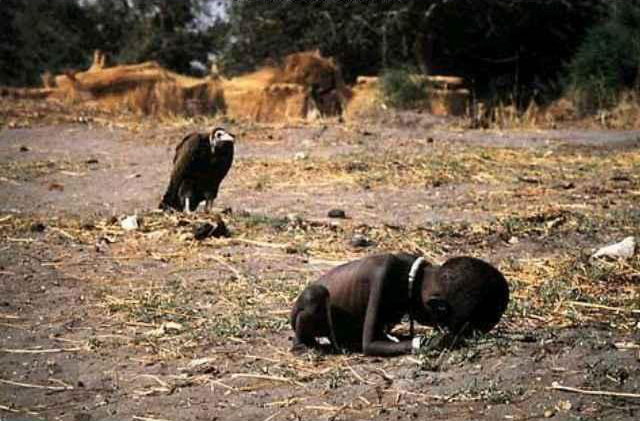
In March 1993, photographer Kevin Carter made a trip to southern Sudan, where he took the now iconic photo of a vulture preying upon an emaciated Sudanese toddler near the village of Ayod. He snapped the haunting photograph and chased the vulture away.
Carter eventually won the Pulitzer Prize for this photo, but he couldn't enjoy it. "I'm really, really sorry I didn't pick the child up," he confided to a friend.
Consumed with the violence he'd witnessed and haunted by the questions as to the little girl's fate, he committed suicide by carbon monoxide poisoning three months later.
This is my poem based on the photograph in tribute to Kevin Carter. It was awarded honorable mention in the Scribophile "Humanity in Poetry" contest.
Child's Pose
I've wiped the lens
with the edge of my shirt
over and over again
each time hoping
to find her
digging grubs from the coolness of mud.
Or sifting millet
with agile fingers
looping through the grains.
Haunched
on strengthened knees,
feet anchored to the ground,
circled hands cupping drops
from the catalyst of rain.
The sharpness has faded,
the background obscured,
but her pose
remains unchanged.
Laid down on the trek,
did she long for the womb,
the fluid float of a weightless embrace
to carry her once again?
Or maybe she sought
to sink beneath
the stratum of clay
to entwine with roots
that would keep her
until Spring.
Earth, too parched to absorb another child
rejected her hunger,
and offered her up
crouched limbs,
caged spine,
bones bracing and
biding
as the talons and lens approached.
The scavenger,
patient and poised,
stilled to her flesh and the
vapored stench
of urine, bile and bowel.
I willed it to advance,
spread wings
just once.
And I waited.
Not a squawk, not a twitch
not a breath, not a click.
A war of observation,
there was no retreat.
The few steps I could have taken
were a vastness bridged by fear.
She held her pose,
too weak to accuse.
I never saw her eyes.
Forgive me.
I'll reside unseen
in the negative space
where the air
leaks promised sleep.
Sunday, June 19, 2011
Pluck: A Poultry Tale + Recipe

"The best way to execute French cooking is to get good and loaded and whack the hell out of a chicken. Bon appétit. "
— Julia Child
There was a time not so long ago when, if I didn't feel like cooking, I would drive a good distance from our house in Savannah to The Fresh Market to pick up dinner. On those evenings, I would grab a basket, walk straight past the wooden tables displaying woven wicker crates bursting with gigantic blush pink apples, baby spinach and arugula. I would shoot past the acrylic, lift-top candy bins and the international chocolate shelf, the artisinal cheese display, the barrels of aromatic coffee beans and the nut grinding station, then weave my way through the biscotti and imported "biscuits" aisle, which brought me to the gourmet deli section. And that's when I would smell it. What I had come for. The rotisserie chicken.
Oh, how I miss that rotisserie chicken: White Wine Herb, Lemon Rosemary, Butter Garlic, Honey and Thyme or Natural (which, they should call "elegantly simple", for that is indeed what it is.) I loved to watch them turning ever- so-slowly on their sabers, the top one dripping it's flavorful cooking juices onto the one below, creating a cascade of savory essence, basting, coating, dripping until each golden droplet suspended and finally splattered and sizzled into the pan below. Watching this process, I theorized that the chicken on the very bottom must be the most flavorful and tender, as it had received all of the drippings from the rungs above. On those occasions when I timed it right and could pick my own chicken right off the rotisserie, that's the one I chose. My piping hot, herb-encrusted chicken nestled inside the foil-insulated bag in my basket, I would wind my way back through the vegetables and fruits (ok, and maybe the international chocolates) to complete my dinner. Those were the days.
In Senegal, I usually dig a chicken out of the freezer chest at our local grocery and dump it into an insulated bag (to keep it cold this time) as quickly as possible. Those suckers are really, really cold. And heavy. Then I met a Senegalese man who raises and sells organic chickens. I ordered one to be delivered the day I was having a dinner party. I would be making Zuni Cafe's famous Roasted Chicken and Bread Salad for one of Richard's new clients and his wife.
On the morning of the party, I was on a roll--I had decided that this time, I was not going to let myself get stressed out. Instead I would be organized, ready, cool and calm. I would have dinner prepared, the table set, my kids bathed, the animals fed and the kitchen cleaned, leaving myself enough time to actually shower and have a much-deserved glass of wine well in advance of our guests arrival at 7:30.
All was going well. I had the bread salad ready at 2:00, or as ready as possible, as the final step is to pour the hot pan drippings over the cubed and grilled bread chunks and then toss with arugula. I had the table set, dessert made, the wine chilling, the green beans trimmed and the orange gremolata ready to pour over the beans once they were cooked. All I needed was the chicken. At 4:00, just as I was putting Sunny and Jamie in the bath, I heard the clip-clop of a horse cart pull up outside. Yes, the chicken. I ran and opened up the gate and there indeed was my organic chicken man, right on time.
He pulled an old rice bag from the back of his cart and reached inside, pulling out a fully-feathered, just killed bird.
"No, no, no", I said, shaking my head. "There must be some mistake. The chicken I ordered is plucked, cleaned and has no head or feet," and, I thought to myself, doesn't look like Ginger the Hen in "Chicken Run" which I had unfortunately watched with my kids the day before.
He laughed and tried to hand me the chicken, but I backed away. "Madame," he said, "you ordered a chicken and that is what I have brought you. You're lucky I killed it for you." With that, he carefully placed the chicken at my feet, got back in his cart and clopped away. I ran after him, hauling the chicken along by the feet, shouting, "but how do I get the feathers off?!! Wait!! Don't go!!"
In situations like this one, (i.e. an entire three pound chicken that needed to be de-headed, de-clawed, plucked, "voided", washed, prepared and roasted in two and a half hours), I have been known to succumb to something akin to Tourette's Syndrome. Sunny and Jamie ran outside with towels on to see why Mommy was standing in the courtyard shouting obscenities, holding a dead chicken by the neck.
"Get your father on the phone, now! . . . Please."
As I tried not to hyperventilate, I heard Sunny, who loves nothing more than to push the #1 button on my cellphone to call her Papa, leaving Richard a message:
"Papa, it's me, Sunny. You better get home soon. Mama's cursing at a chicken. She used the really bad word."
I frantically Googled "how to pluck a chicken". A surprising number of results popped up. I decided to skip the Mount Calvary Missionary Baptist Church video on YouTube entitled "Ms. Dudley Shows How to Pluck the Chicken" because it was seven minutes long and I didn't have seven minutes. I did however bookmark it for later viewing. Scrolling down, I learned fairly quickly that one only need place the chicken in a pot of boiling water and let it sit until the feathers loosened and could be easily removed.
While the chicken sat in it's pre-pluming bath, I thought it would be a good idea to sample the wine. Two glasses later, I reached into the pot, pulled out the chicken and realized it would be easier if I got the neck/head and feet off first. I somehow managed to do this rather smoothly, finding the joints easily. That accomplished, I took a deep breath, reached into the pot (which had now cooled slightly) and began ripping feathers out. The downy ones came out quite easily, but the wing feathers were more stubborn, so I asked Jamie to please find my eyebrow tweezers. By now, our three cats had become very interested in what I was doing and had climbed onto the counter and were pacing like circus tigers. Tweezers in hand, I began to tug at the more difficult quills. As my hands were wet, I was covered in chicken feathers which were plastering themselves all the way up my arm. Sunny had pulled up a stool next to me and was cheering me on. "You're doing a great job Mom." She kept asking me if I didn't want another glass of wine.
At 6:00, the chicken was naked as a . . . well, you know, and I braced myself for removing the innards. I got a scrap bowl out, cut the skin around the cavity and reached in. I don't know that I could identify what I pulled out, but I placed it all in the bowl to cook later for the cats. I scrubbed my hands, arms and the chicken clean, inside and out, and placed it in a roasting dish. It looked just like it was supposed to! I felt triumphant, giddy, plucky even!
Just as I was popping my beautifully dressed and tressed chicken into the oven, one of the cats snatched the entrails out the bowl and trailed them across the counter, down the hallway and up onto Sunny's bed where she proceeded to gnaw on them ferociously and howl at me viciously if I tried to get near her. The resulting mess topped my 'grossest thing ever' list, Sunny's bed had to be changed and Sunny herself needed lots of comforting. She feared that her favorite Hello Kitty sheet (ironic, don't you think?) would never be the same. And, I found, I needed another sip of wine.
Twenty minutes later, I had just enough time to wash my face, brush my teeth and throw on a dress and some lipstick. My cheeks already had that healthy 'just plucked a chicken in record time while downing a bottle of wine' adrenaline glow, so I skipped the blush. The chicken was starting to smell pretty good and, although the recipe doesn't call for it, I basted it with the remainder of the wine bottle I had so thoroughly sampled. When Richard arrived with our guests, who I was meeting for the first time, I wanted to drag him into a corner and tell him everything that happened, but I would have to save it for later.
Somehow, I got dinner on the table. I nervously waited as our guests took their first bites. No one said anything, so I quickly scooped up a forkfull of chicken and bread salad and was relieved that it had turned out well, really well. The woman turned to me and said, "this chicken is absolutely delicious. Did you use white wine?"
You could say that.
___________________________________________________________________________________________________________________________
Actually, it was excellent, which is why I'm sharing the recipe. If you want to impress someone or simply cook the best roasted chicken dish you've ever tasted, you should give it a go. I didn't read the recipe carefully in advance--the chicken is supposed to be brined two days in advance--oh well. This is a link to my absolute favorite cooking blog and the recipe. Enjoy. Oh, and Bon Appetit!
http://smittenkitchen.com/2008/12/zuni-cafe-roast-chicken-bread-salad/
Subscribe to:
Posts (Atom)